Stuart Farm

  • Our Story
  • Shop
    • Our Store
    • Where to Buy
  • Come Enjoy a Farm Stay!
  • Our Classes
  • Fertrell Products
  • Contact Us
  • Blog Posts
    • Our Animals
    • Mother Nature
    • Our Garden
    • Recipes
    • Farm Life
    • Projects
  • Consultation Services
  • 0 items

From Breeding to Butcher…Part 2 Piglets!

Posted on February 16, 2017 Written by Serena 2 Comments

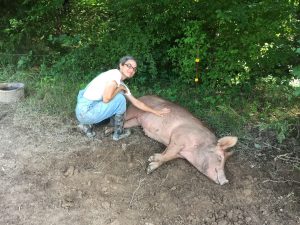
When we have a pregnant pig, I am beside myself with anticipation.  I am constantly checking for discharge that would indicate a miscarriage, giving out extra belly rubs, and trying to see and feel any movement.  The closer it gets to farrowing day, the more I check on them and the more I worry.

It takes a sow 114 days from breeding to give birth or farrow.  It is commonly calculated as 3 months, 3 weeks, and 3 days.  Sows are pretty spot on when it comes to the due date.  With a gilt, or first time mom, it can be +/- one or two days, but usually it is exactly 114 days.
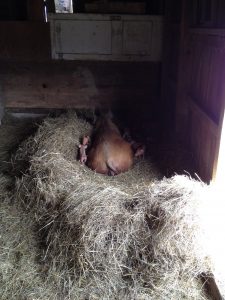
Gertie’s nest.

Gertie farrowed right on day 114.  She was sharing a paddock with Flossie and Corky, and 2 days before her due date, we split the paddock so only she could get in the barn.  We cleaned out the barn and added a nice thick layer of hay.  The day before, she would lay on the cool ground and I would rub her belly.  If I stopped, she would give me a grunt.  I could see the babies moving around and knew we were close.  She had also made a HUGE nest of hay and straw.  When she farrows inside the nest, all the babies are contained.  The day of, I checked on her every hour or so, but she wasn’t ready until 9pm.  I came in and saw 1 baby looking for a teat.  I walkie-talkied Fred that it was time and bring the supplies.

When Gertie first farrowed with us, a baby was stuck (hence that baby’s name-Corky) and we gave oxytocin to help push it out. Later I learned that should have been the last resort and manual manipulation was the better course of action. Now we have a supply kit with gloves and lubricant. Since it was cold, we had towels to quickly dry them off.  One after another they were born and once dry, started nursing.  Fred went home and I would radio back with updates…number 7, then 8 and 9, 10, 11, a lag until 13 and 14.  It was a long exciting night for me.
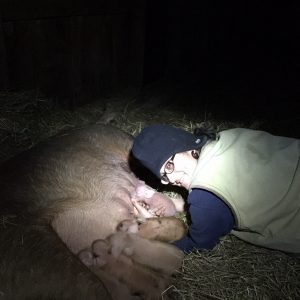
Making sure everyone gets fed.

Baby pigs hit the ground running, literally.  They come out, wriggle out of the sac, and start for the teats.  They may not know where they are going, but they are going!  You can tell they are listening to the sow and siblings to find the food.

Two of the piggies were runts.  They were half the size of the others.  We tried our best to keep them warm and get them nursing, but they didn’t make it.  One just disappeared.  When a baby dies, to keep predators away, the sow will either remove the baby or eat it.  Sometimes, the sow will just eat each baby as it is born.  When I found this out, my anxiety level about the whole thing went through the roof.  I worry about the animals health when everything is going well, this was something I just didn’t want to have to witness.  Thankfully Gertie was a great mom to all 11 babies.
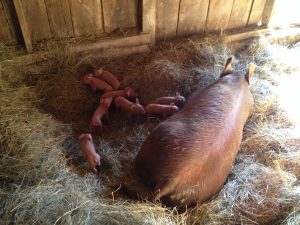
Corky’s nest.

When Corky farrowed her 8 babies, I missed the whole thing.  I KNEW she was close when she went from begging for belly rubs to jumping up and going after me, only to flop back down and grunt for me to rub her more.  She was due on a Sunday, but delivered in the wee hours of Saturday morning.  When Fred went to feed that morning, he came back to report 8 healthy babies all nursing.  I was bummed, but happy all seemed to go well.  The first farrowing can be difficult and some gilts will have what they call “gilt hysteria”.  They basically freak out about farrowing and can either eat or trample all the babies.  We were very lucky she was such a good mom.
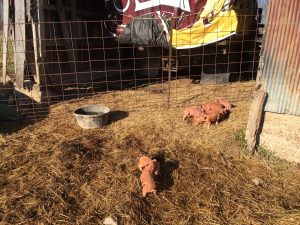
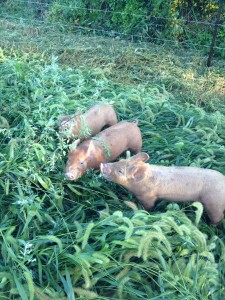
Exploring at 3 days old.

There are a few things we don’t do to babies that other producers do.  Every time you handle a baby, you put yourself and them at risk–sows do NOT like to hear their babies squeal and can charge at you and trample any baby in the path.  Some producers try to breed to have mellow sows so they can handle the babies without issue.  But as far as I can tell, momma protects baby and that’s that.

We don’t give iron shots.  If the babies and mom are on dirt, they can get all the iron they need from that.  The sow will get in the mud, go back to the babies, they latch onto nurse — instant iron boost.

We don’t clip needle teeth.  Those babies have some sharp teeth.  And yes, they scratch each other up and blood on a tail is not uncommon and I am sure all the grunting the sow does is her telling them to knock it off with the teeth already and just suck!  But everyone survives just fine.

We don’t dock tails.  The reason for doing this is so they will not bite off each others tails.  Again, we have had tail biting, but everyone heals up just fine.   With plenty room to move around, I don’t know why they would get aggressive enough to take off a tail.

We don’t ear notch.    A special tool is used to cut a “V” notch in a certain pattern on the outer edge of the ears.  It’s done at about 2 days old, so the blood hasn’t begun to circulate through the outer ear.  The notching system numbers each pig for identification and registering.  To register Tamworths it’s required to ear notch, so we don’t register.
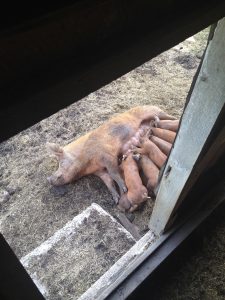
Lunch outside.

We don’t separate to wean until after 10 weeks old.  The babies, and sow, will naturally wean around this time.  Once feed intake has increased, we will separate everyone in adjoining pens for a week or so to let the sow dry up.

We do castrate our male babies.  We both hate this and wish like heck to have as many girls as possible.  Castration is done before 7 days old, usually between 3-5 days.  After 3 days they have had a good dose of colostrum, have the sow’s antibodies in them, and their immune system is kicking in.  Fred holds them upside down, I clean the area and find the testes, make two slits with a sterile blade, pop them out and pull.  Cutting can do more harm than pulling.  When you pull it breaks off at just the right place.  We don’t apply any antiseptic to reduce the stinging and them rubbing the ground.  After a day or two the swelling has gone down and the slots have a nice scab.  In about a week, it will be completely healed.
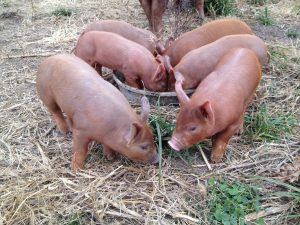
Eating from momma’s pan.

Once a sow farrows, her feed intake increases by 1 pound of feed per piglet on top of their normal ration.  Gertie was getting 16 pounds of feed a day and had the milk production to prove it.  The babies will gain about a pound a day nursing.  The first few days is a lot of sleeping and nursing. By day 3 they are following momma onto the pasture.  They start rooting almost immediately in the nest and nibbling at grass at about a week old.  After a few weeks, the piggies begin to get interested in momma’s feed and they slowly start to eat their own ration until they are not interested in nursing.
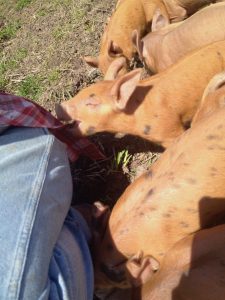
Happy piglets!

Unlike Gertie’s previous litter of 3, her new babies wanted nothing to do with me.  As much as I tried to befriend them, it just wasn’t happening beyond an occasional belly rub or ear scratching.  I missed all the loving I could give Shooter and Corky–getting them to flop over with legs in the air for belly rubs or snuggling next to them in the hut.  These new babies would let me scratch on them, realize what was happening, snap out of it, and run away.  During feedings I would get as many scratches in as I could.  They weren’t unfriendly or skittish, they just didn’t want to be snuggle buddies.  So all this time from farrowing to 7 months, I do my best to make sure they are getting as much attention as they will allow me to give.  In that time, whether they feel the same or not, I become attached to them.  I love that the one with big jowls like his dad will let me scratch him only when no one else is watching.  I love calling them through the woods and having them follow me.  I love the time after feeding when they all just lounge around and one will come over to sniff at me and plop down a few feet away.

Corky’s babies were a little more interested in me.  I would go in twice a day while Corky ate and give them rubs and talk to them.  One girl would always come and lay next to me while I scratched her.  Now when I come to see them, everyone runs up and all around me trying to figure out the best way to eat my boot or pant leg.  And one by one, I start to rub their bellies and they start dropping like flies with big smiles on their faces.  And just like with Gertie’s litter, I am attached to them.  After all, the reason we spend so much time and effort in how we raise them is so they will have a good life and that includes being loved. 
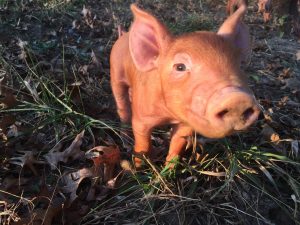
 

Next…Part 3–The Piggies Go To Market.
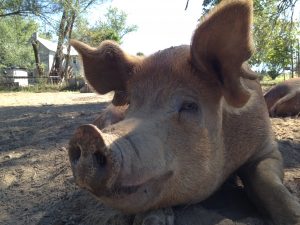
Filed Under: Our Animals, Pigs Tagged With: pigs

From Breeding to Butcher…Part 1

Posted on December 6, 2016 Written by Serena Leave a Comment

img_5113I had no experience raising pigs before moving to Missouri. Fred grew up raising and butchering pigs, so all of this is old hat to him.  With my vast lack of knowledge and huge desire to have pigs, I did what I knew to do–read as much as I could to get all the info I could to be prepared for everything that could possibly happen. I also talked to an old timer who gave me such sage advice as “if the pig ain’t dead, it’ll be just fine” and “you’ll NEVER be as fast as a pig”.  Both have proven to be quite true, but I still worry over the tiniest scratch and can’t resist getting just a bit closer to newborns with a protective momma around.
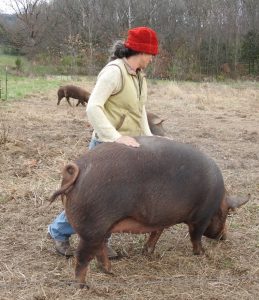
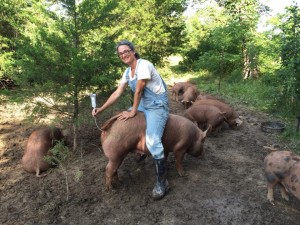
When I think back on what I have learned from experience and what I have read in the past few years, one thing I realized is that our pig operation is not “farrow to finish”, but rather a “breeding to butcher” one.  In this series, I want to walk you through what we, and the pigs, go through from start to finish. First up, breeding.

Sows (females who have given birth) will go into heat every 21 days starting at about 6 months old.  When heat begins, the vulva will enlarge and they may begin to mount other sows/gilts or even try with us.  Breeding is best done once standing heat begins.  Standing heat is when the sow will allow you to apply pressure to her back, turns her ears back, and takes a firm stance.  One way to test if she is in standing heat is to push against her sides like a boar would prior to mounting, then apply back pressure.  If she “locks up” she is ready.  My job starts a few days before they are to begin heat.  Vulva checks, flank pushes, and back pressure until she starts standing heat.  Once we are sure she is standing, we wait 12 hours for the first breeding.  Breeding can occur every 12 hours once she is standing, as long as she is interested.

Pushing on Flossie's flank to test for heat.
Pushing on Flossie’s flank to test for heat.

With both Gertie and Flossie, once we had Rodger the boar on the property, it was easy to tell when they were in heat.  Before that, we had never seen signs of heat.  We bought Rodger for the sole purpose of breeding him to both girls and then butchering him.  At 11 months old, and a different breed, he was smaller than the girls and had a bit of trouble mounting.  When Gertie was in standing heat, we moved her into the pen with Rodger.  The sow seeks out a male to mate, so taking her to him was more natural and safer.  Sows can be very protective of their areas.  After quite a few flank pushes, Rodger would mount Gertie.  Because of the size difference, we had to face her uphill, so her bottom was lower.  Moving a sow in standing heat is not easy, nor is keeping a 300 pound boar from mounting.  We were successful and after a 5 minute lock, they took a break.   This was Rodger’s first time breeding, so we also had to help him…ummm…get into position.  The next day they mated again, and then we removed Gertie.  Once a sow is out of heat, or knows the mating was successful, they will not let mating happen again.

When it was Flossie’s turn, we knew Rodger would not be able to reach.  With him in the trailer, we constructed a chute for her and a platform for him.  We got Flossie in the trailer with Rodger and let him prep her with few flank pushes, and then quickly moved her into the chute for him to mount.  The platform worked like a dream.  No way was he reaching her without it.  He still needed a little help getting into position though.  We did it all again the next day for an extra breeding.

AI with Corky.
AI with Corky.

With two sows, it isn’t cost effective to keep a boar.  When we decided to breed Corky we did AI, artificial insemination.  It’s basically all the same prep work-flank pushes and someone sits on her back to act as the boar-insert a catheter with a tube of semen on the end and let her do her thing.  You see, all that flank pushing that goes on has a purpose.  When the boar does this, it stimulates the uterus to start contracting.  This contracting is what pulls the semen in.  No flank pushes = less success.  With Corky, we decided to wait until she was a year old to breed. While she was capable at 6 months, we don’t think at that age they are ready mentally or physically to give birth.  It takes a lot out of a gilt (first time mom) and a lot of things can go wrong, so waiting seemed like the best course of action. This also made it possible for her to be around her 11 siblings when they were born to get used to having little ones around.

Once breeding is complete, you wait 21 days and check for standing heat.  If there are no signs of heat, you can be pretty certain the breeding took.  The first 35 days of the pregnancy are the riskiest.  You want to make sure you aren’t stressing the sow with long trailer rides, introducing new animals, or having them too hot or cold.  We think Gertie’s first litter was so small because we moved her too close to day 35 and Flossie probably lost her whole litter from being stressed during her great escape.

Next..what to expect when your sow is expecting–piglets!

Post AI belly rubs to keep the contractions going.


Filed Under: Our Animals, Pigs Tagged With: pigs

Gertie and Flossie…and the Great Pig Caper!

Posted on October 14, 2015 Written by Serena 1 Comment

2015-04-23 19.06.45
First day at the farm

We were very happy to find two pregnant Tamworth sows, sisters Gertie Lynn and Flossie Mae, to add to our farm.  Luckily, we had a pen already set up and thought all we needed to do was get some farrowing (birthing) huts set up and wait for babies.  The pig pen is a good size, and as soon as the girls unloaded, they were busy rooting.  We didn’t think to check the panels, and unfortunately they did.  On day two, both girls were out.  They had rooted by a weak point where the panel connected to a post and off they went.  Mom and Dad’s small dogs scared Flossie and she went running. When she made it into a paddock with the cows, she really started RUNNING.  Fred said he could not have caught her if his life depended on it. Meanwhile, Gertie followed me back to the pen and was feasting on boiled eggs.

We thought she was just in the next paddock over, but when we saw tracks outside the fence and in the cropland, we knew it was going to be a bit more difficult to get her back.  We spent the rest of the daylight hours tracking her.  In and out. Back and forth. Round and round. Fred stayed on her tracks until we finally tracked her to an island in the river.  We emptied out bucket of food and headed back home with plans to return the next morning.

The next day, we found tracks and rooting on the island with no evidence she had crossed back over the river. Fred caught a brief glimpse of her, so for 2 days we dumped more food to keep her there while we figured out how we would either catch her or befriend her enough to get her to follow us back.  Meanwhile, we were calling friends to arrange a rescue party.  One had a tranquilizer gun, so we were planning on using that, and carrying her out on a sling Fred made, putting her on a make shift sled, and then dragging her to the trailer.  Hopefully, all before she woke up.  On the third day, with 4 friends, we went full-on missing person search line walking from one end of the island to the other…with no sign of her.  Thinking she must have left the island, we moved the line to the woods back across the river. Still no sign of her.  We went home exhausted and worried.

2015-04-23 19.23.46
Gertie Lynn and Flossie Mae

There was no risk of rain, and the ground had dried up enough from the rain 4 days before, we decided that the last effort would be for me to take Gertie down in the trailer and stay the night.  I packed up warm clothes, grain, and a dozen boiled eggs.  We parked along the woods across from the island.  I teased Gertie a bit with some food to make her squeal and gave her a few smacks on the butt.  She wasn’t happy about being in the trailer, but she settled down, only rocking the truck and making a few snorting sounds from time to time. At about 1 am, I heard what I thought was Gertie making a fuss, but the truck wasn’t moving, and it was coming from the front, not the back.  I slowly opened the bag of eggs and as quietly as I could, opened the window and dropped them out one by one.  Once Flossie started to eat them, I softly said her name. She didn’t run.  The plan was to get her eating around the truck and come back the next night to get her.  I pressed my luck. I slowly opened the door and listened for her reaction. Nothing.  I slipped out of the cab and started to shake the bag of grain.  By the time I reached the back of the trailer and opened the gate, Flossie was half way to me.  All I could think was, “you have to be kidding me!”  I grabbed Gertie’s pan and shook it with grain and Flossie stepped right into the trailer.  I skirted past her and shut the gate.

I called Fred on the walkie-talkie and told him, “Come meet me at the farm, I have the pig!”  Driving across the field of corn stubble in the fog, it felt like a dream. What are the chances of her only knowing me for 2 days, being on her own for 4 days, and her walking into the trailer like we are old pals that do this every day?  I would have said very slim chances, but apparently boiled eggs and a sister must have put the odds in our favor.

I am so happy we did not have to tranquilizer her. For her sake and ours.  And I am happy that she looks like she did not have any run-ins with other animals.  Both girls are back in the pen with an electric wire reminding them to stay in.

Flossie taking in the sunshine.
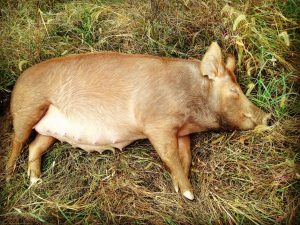
Gertie aways has a smile on her face.
Taking a break from the pasture. Momma Gertie thinks big baby Shooter makes a perfect snout rest.
Everyone in the garden to eat, root, trample, and add manure.

Filed Under: Our Animals Tagged With: pigs

PIGLETS!!!

Posted on October 14, 2015 Written by Serena 1 Comment

IMG_4851
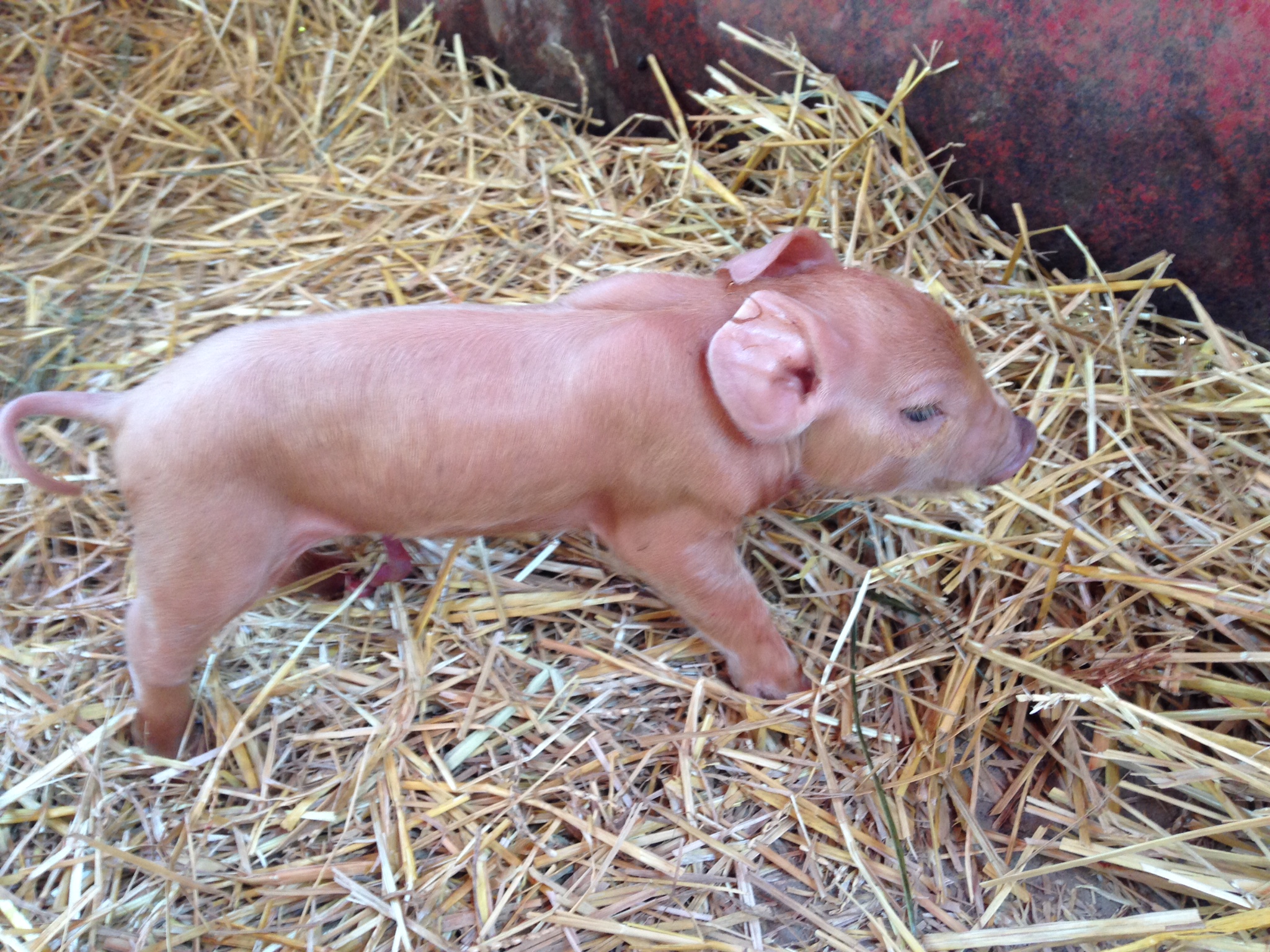
Just born and already up and running.


I once read that if you call a baby pig a piglet, it shows you are not a serious pig farmer.  And you know what, I am fine with that. Because we have the cutest PIGLETS EVER!

I have always loved piglets. They are just so darn cute!  I did an internship at the Houston SPCA and we had a litter of piglets dropped off.  I couldn’t help myself and I went into the pen with them.  My supervisor came in yelling, “What are you DOING?!” I said, “They’re just too cute, I had to!” “NO!!!”, he screamed, “they have mange!!!”  Truth be told, I only got out of the pen because I knew he wanted me to. Seriously, they were that cute.  And now that we have piglets, I am not much better.

Like most birthing I am a part of, I am a wreck.  We got Gertie’s house set-up the day before she farrowed.  We had plans of building a fancy house, but ended up backing the trailer up to the fence, setting down a mat and straw, building a roll bar so the babies can get away from momma, and letting her in.  She went in surprisingly easy, had been talking to Flossie in a strange voice all day, and kept rubbing on my leg, so I knew she was close.

The next morning she farrowed.  Thankfully, we had a 5 am knock on the door that the cows were out.  Once the cows were back in, we went to check on Gertie and there was one stillborn and one live pig.  We waited and waited but nothing was happening and there was no afterbirth.  Luckily, I had a neighbor with some oxytocin and 30 minutes after the injection, out shot two more piglets.  It was a small litter, but all were healthy.  There were two girls, Solamente and Corky, and one boy Shooter.  Solamente, because we thought she was the only one; Corky because she was the one blocking the way; and Shooter because he literally shot out. The afterbirth came soon after, and Gertie quickly cleaned everything up.  Contrary to popular belief, pigs are very clean and keep a very tidy house.

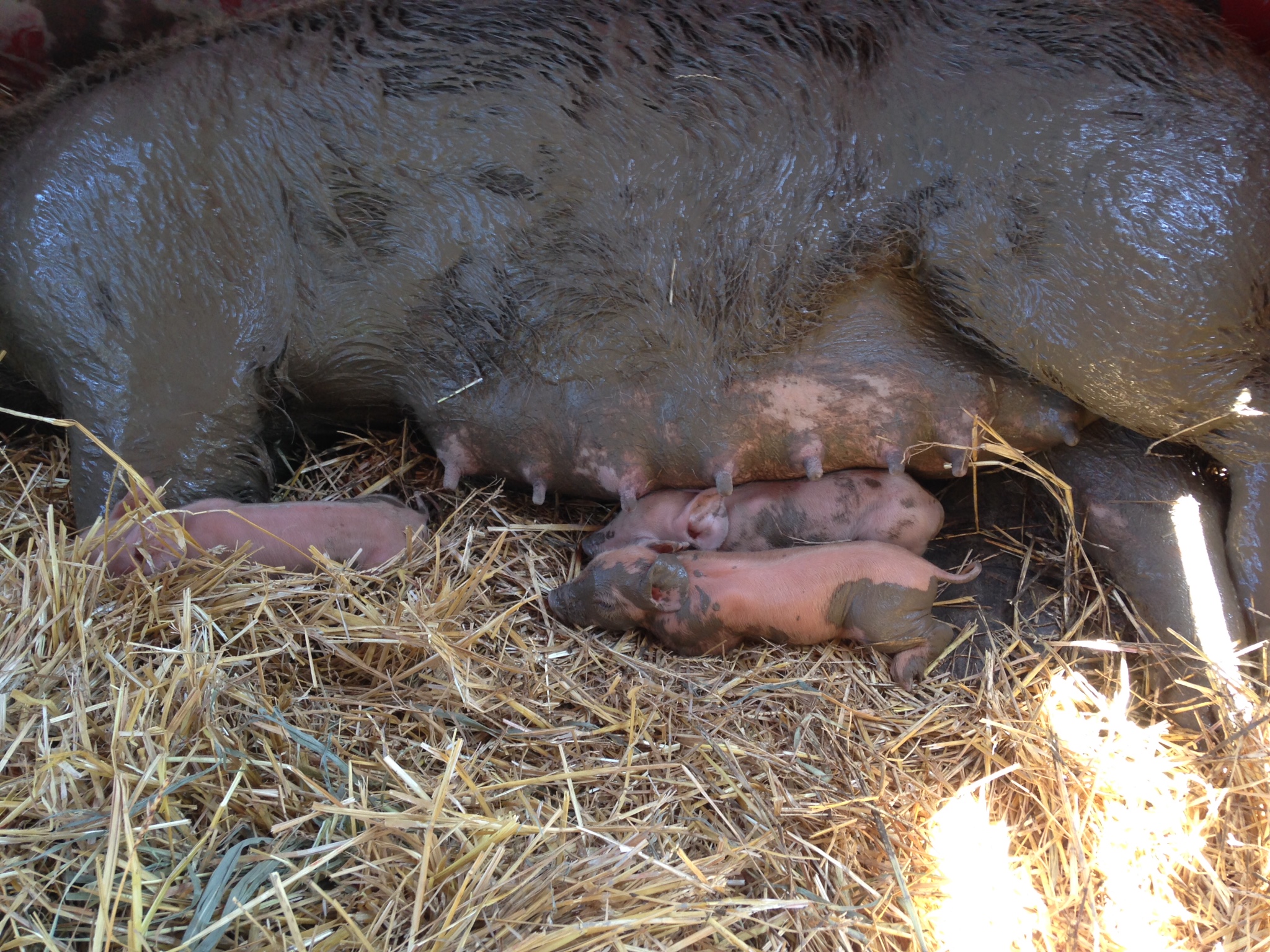
A little mud never hurt anyone! Especially if you are a pig.  The pigs will get iron from the dirt so we don't need iron shots.
A little mud never hurt anyone! Especially if you are a pig. The pigs will get iron from the dirt so we don’t need iron shots.

Once everyone was settled in and nursing, it was time for me to do my thing…sit and watch.  When we have a new baby, the whole day, if not two or three days, is shot for me.  I doubt I will be any different witnessing my 100th birth.  It’s just a magical experience to watch momma and baby figure it out together.  And it’s when I get to learn.  With the piglets tucked in the straw, Gertie decided to cool off in the wallow.  When she came back in, the piglets scrambled to nurse and were covered in mud.  My first thought was, “is that ok?”, but figured she knew best.  And sure enough she did.  Piglets who are not exposed to enough dirt, may need iron shots. Gertie was making sure that was not needed.  And from then on, instead of pink piggies, we had dirt balls. Which is as it should be.

No, really, Auntie said we could stay in her house.

Gertie was a great mom. She was protective of them with us, but not to where we thought she would hurt us.  With each day, we could handle them more with her present.  And Flossie was a terrific auntie.  You hear about a momma pig or another sow eating babies, and I was so afraid of that with Flossie.  But she took to them like they were her own.  And since we think she lost all of hers during the Great Pig Caper, her gentleness towards them was a huge relief.  We separated the pen so each sow had a side, but the wire was high enough for the babies to go under.  And a lot of their time was spent with Auntie Flossie in her house. They would go to momma to eat, then go back to Auntie.

You will notice in the photos their ears are notched.  We do not like this practice, but in order to register them, they must be notched.  This helps to keep track of the breed numbers and assure they are not crossed with another breed.  Since Tamworths are considered “threatened” by The Livestock Conservancy, keeping the breed lines pure until their removal is one of our goals.  It also helps us to identify a pig easier and keep track of any treatment or injuries a certain pig may have recieved. We ear notch at 2 days so they can get enough colostrum to help with healing, but are still young enough that there is little blood flow to the ears.

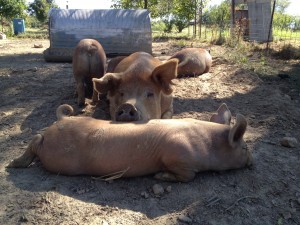
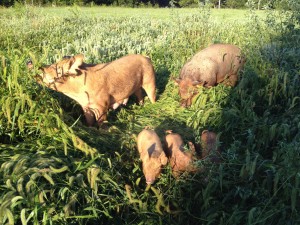
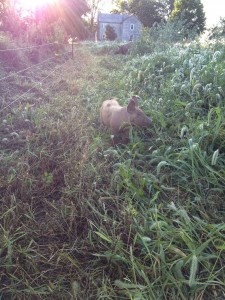
They have been doing well on pasture; learning what to and not to eat.  Pasture time is a bit more play time for them.  Lots of room for piglets to run and play chase.  Acorns are starting to fall and soon everyone will be in the woods putting on some winter weight.

Trying to figure out what to eat.
Shooter in the garden.
Everyone in the garden to eat, root, trample, and add manure.
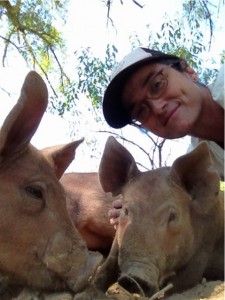
Solamente, Shooter, and me.


Filed Under: Our Animals Tagged With: pigs

  • « Previous Page
  • 1
  • 2
  • 3
  • Next Page »

Welcome to Stuart Farm!

We’re Serena and Fred Stuart. While raising healthy and happy animals is our #1 goal, we’re also here to serve you! If you’re looking for help in navigating healthy eating and living, you are in the right place! We’re here to answer your questions and help you feed your family meat and eggs you can feel good about. We share farm stories that gives you a peek into our life, recipes to try, health tips, and more. We hope you enjoy coming along on our farm adventures.

Connect with us

  • View StuartFarmLLC’s profile on Facebook
  • View stuart_farm’s profile on Instagram

Contact Us

573-764-2324 please leave a message .
Farm hours are by appointment only.

Tags

Beef recipes broth chickens delivery Devons Dorkings Eggs Farm Life Freedom Rangers garden lard pigs Pyrs raw diet recipes recipes sweets Silver Fox Rabbits Sugaring

Categories

  • Blog Posts (73)
    • Farm Life (39)
    • Mother Nature (1)
    • Our Animals (24)
    • Our Garden (2)
    • Pigs (5)
    • Projects (1)
    • Recipes (16)

Recent

  • 2025-2026 Our Years of Transition
  • Our Farmstay Is Now Open!
  • The Best Way to Take Charge of Your Health
  • Love is…
  • My Summer Reading List

Archives

Copyright © 2026 · Focus Pro Theme on Genesis Framework · WordPress · Log in

Loading Comments...