Stuart Farm

  • Our Story
  • Shop
    • Our Store
    • Where to Buy
  • Come Enjoy a Farm Stay!
  • Our Classes
  • Fertrell Products
  • Contact Us
  • Blog Posts
    • Our Animals
    • Mother Nature
    • Our Garden
    • Recipes
    • Farm Life
    • Projects
  • Consultation Services
  • 0 items

Corky’s Piglets

Posted on November 23, 2019 Written by Serena 2 Comments

I’m always excited about piglets.  The weeks leading up to the big day, trying to guess when it will happen, pampering the momma, even staying up late in the freezing cold, it’s all worth it.

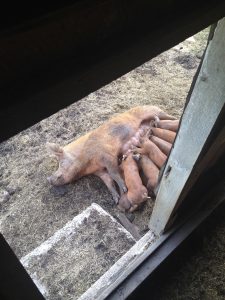
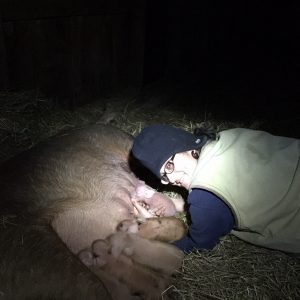
Last week, when I got home from driving my afternoon school bus route, Corky had started to farrow.  The nice thing about attending farrows is I get to know the changes in breathing and movement that go along with the process.

As I watched her, I knew she still had piglets to birth.  The way she kicked her legs, a certain grunt, it all said: “I’m working on more!”

I cleaned each one up and told Corky she was doing a great job. We don’t use heat lamps, so I made sure each stayed close to her for warmth.

I stayed with her for two hours while she added 3 piglets to her litter.

When she was having trouble getting one out, she’d half sit up, and roll back down.  Sure enough, one would come out right after.

But when she stood up, turned around, laid back down, I knew that was that. Her breathing slowed and was easy.  She softly grunted at the piglets to come eat and they did.
I waited another 20 minutes or so and the afterbirth came.  My heart sank.

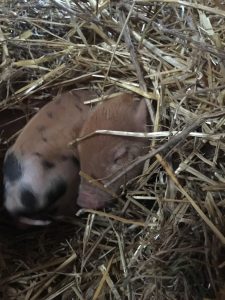
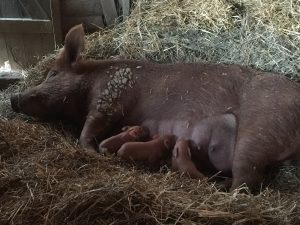
She delivered 5 piglets.  One stillborn with leg deformities, four alive.  One of the four also had deformed legs and we had to put it down.

That leaves three piglets with this litter.  Her previous litters were eight and two.

If Corky were solely a pet, I’d be happy to keep her and never get another piglet from her. But she’s not a pet. And sows that produce so few piglets don’t work for our business.

These were to be our farmer market hogs, so our pork will be in short supply for the summer. Not a good thing.

Having piglets, even just three, is hard on the sow. After the piglets are weaned, we’ll let her regain her conditioning and make an appointment at the butcher.

It’s not an easy decision to make, but a necessary one for us to be sustainable, to continue producing meat, and to keep lesser quality genetics out of production.

I will enjoy these few months with Corky and when the time comes, cry my eyes out when we say goodbye.
Filed Under: Our Animals, Pigs Tagged With: pigs

Introducing Trudy’s Piglets!

Posted on June 25, 2019 Written by Serena 5 Comments

Every farrowing is different. Every sow works through it in her own way. That’s part of why I love to be there when it happens.
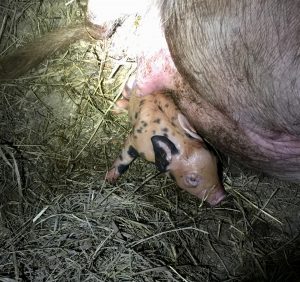
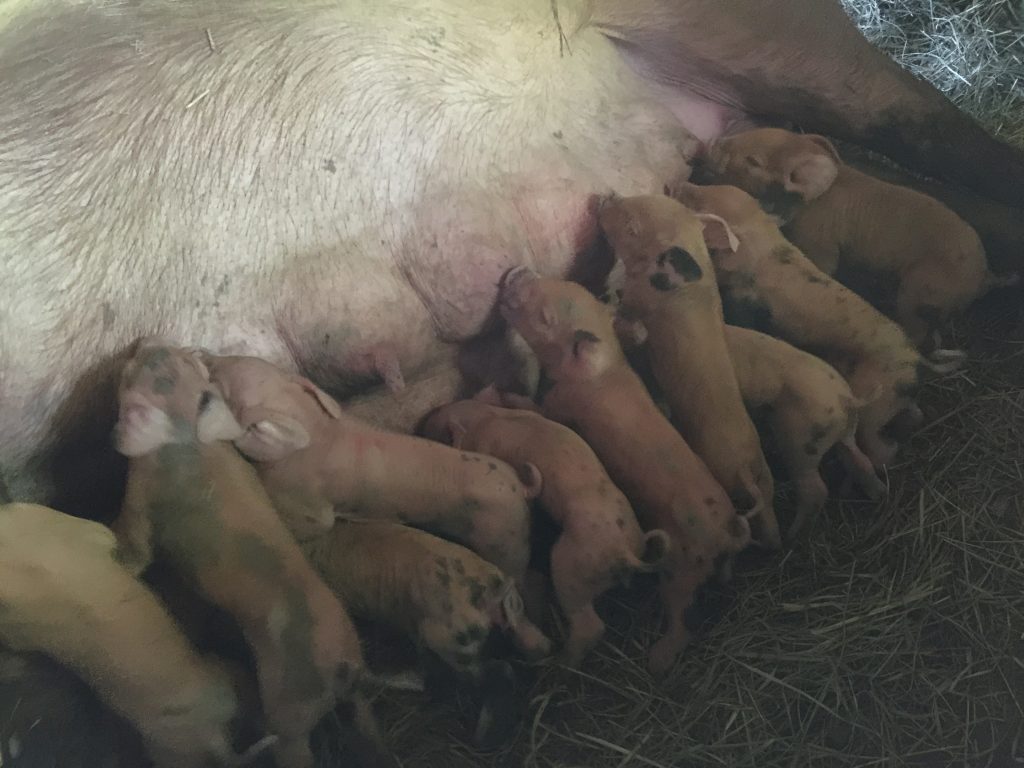
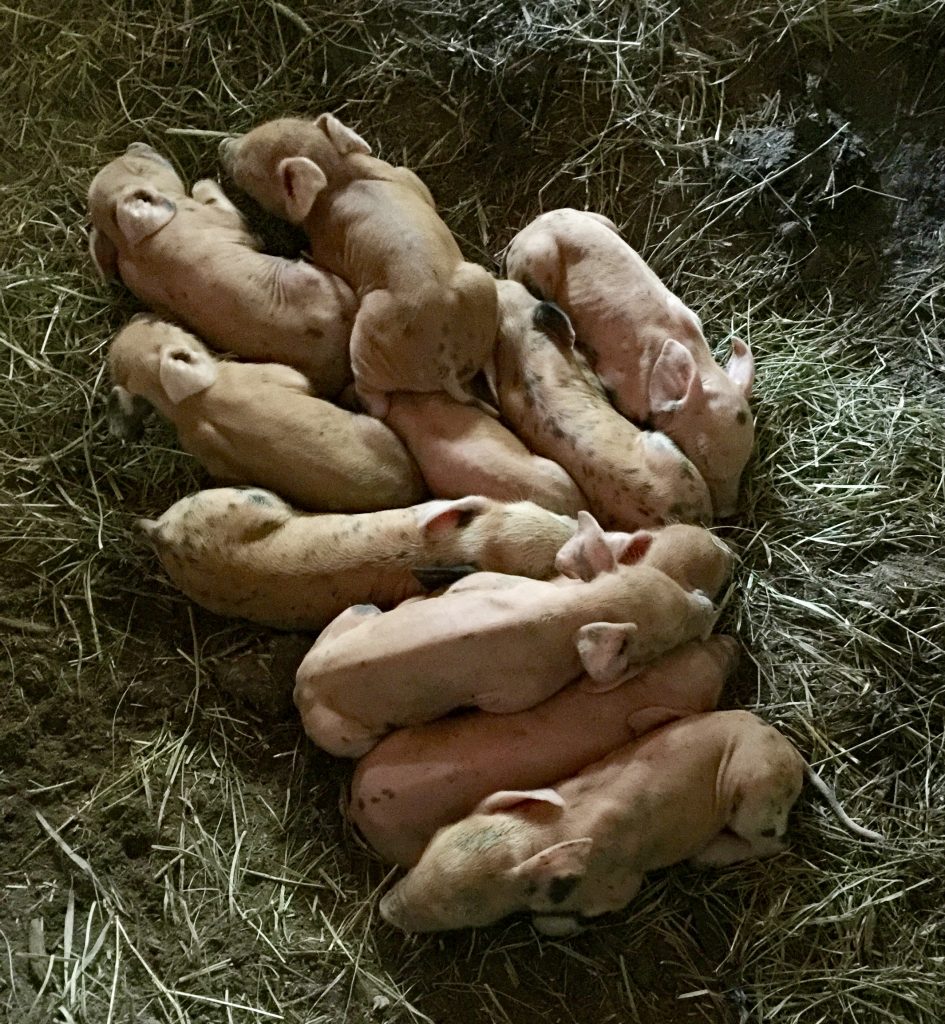
Yesterday afternoon, Trudy was on her side, up and down, and really uncomfortable, so I put a bale of hay into her stall. She immediately got up and started adding it to her nest and then peed. Both good signs!

Contrary to popular belief, pigs are quite clean and do not use their living space as a bathroom. So when she chose to use a corner as a toilet, I knew for sure, she was ready.

I checked on her once after chores and decided to come back later. When I returned at about 8:45pm, there was one piglet roaming around nowhere near Trudy. UGH!

The first piglet not nursing is an issue for two reasons. 1–nursing helps release oxytocin that helps with contractions. Better contractions mean easier birthing. 2–not nursing means no food, and no food means no warmth.

With her first litter, I was right there with no problem, but it was on pasture. Now, in a confined space, I was worried about how she would react to me jumping in.  And with the sides of the stalls chest high, mud to my ankles in front of the door, and a low ceiling, I had no good escape route if things went bad. Even if I did get in the pen to help, I’d have to walk in front of the bone-crushing jaws of a momma sow in labor to get to the piglet. Not happening. So I waited nervously.

When Trudy started to roll, I knew it could be a long and devastating night. She was trying to push a piglet out with her body. Up and down, rolling this way, rolling that way. With every movement, I cringed hoping she would avoid the piglet.  I coached her with a soft voice, “you can do it, Trudy, just relax and let it come.”  And it did–a huge piglet.

After the second piglet, she moved once more and put her belly facing the stall divider. PERFECT!  I could get into the next stall and help from there.

After I clamored along the edge of the barn, only stepping into the mud with my holey boot once, I was in the next stall and could reach the piglets and her belly.  I got each piglet on a teat and started rubbing the others. Soon number 3 came. 

I don’t know why she moved in that position by the divider, but it worked well. If she wanted to, she could take out the divider without much effort. I think she felt my safety concerns but wanted my help. It also kept the piglets close to her acting as a side of the nest.  And probably most useful, she pushed on it with her feet as she was delivering and having contractions.  I should have worn earplugs. The sound of a 400 lb sow in labor stomping against tin is deafening.

She was doing great! Some came almost right after the other. Some had a bit of a lag. Right as I was thinking, “I’m so lucky to have not witnessed a stillborn or mummy piglet”, she birthed a stillborn.

Of course, in my mind, I could save it. I pulled it over to my side, ripped off the sac and started compressions as I tried to clear the mouth with my finger. No luck. The legs were a bit bony and longer than they should be.  Maybe it died before filling out? Maybe it was a disorder? I don’t know.

Then she passed something strange; what looked like an empty sac. I pulled it over to my side and could see the outline of a small skull and partial spine.  When a piglet dies in utero, the mother’s system will begin to absorb it. I think that’s what it was.

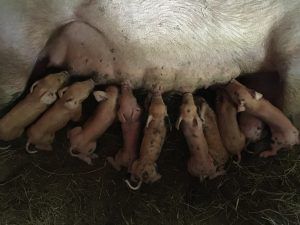
All in all, 11 healthy piglets, about half boys, and half girls were born in 3.5hours.  I stayed to make sure she passed all of the afterbirths–there are 2–and then watched everyone for a while to make sure each had a turn on the teat.

It’s a hard few first days for piglets. Being stepped or laid down on are the biggest issues. Since they can’t regulate their body temp well for the first few days, staying close to Trudy, and littermates in plenty of bedding helps maintain their heat. We breed our pigs for hardiness, so we don’t use heat lamps.

I left with high hopes of seeing all 11 this morning, and I did!  In the next week, we’ll be offering farm tours with some piggie playtime.  Until then, they’re all mine!!!!! 

Filed Under: Farm Life, Pigs Tagged With: pigs

Breeding to Butcher–Part 3 Going to Market

Posted on September 15, 2017 Written by Serena 3 Comments

Our last batch of hogs are back from the processor, so it seems like a good time to talk about the worst part of our job.  One of the most common questions we get is “how do you kill/eat the animals you raise”?  I write about death on the farm here, but the short answer is…it’s hard. Really, really, hard.  Just thinking about it gives me knots in my stomach.
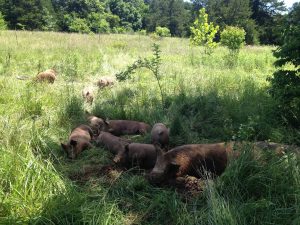
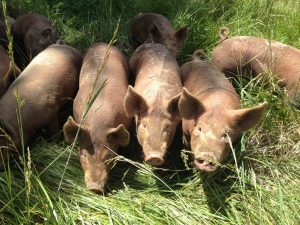
Once the piglets are weaned, they spend their life out on pasture eating grass and rooting up whatever they can find.  When the nuts are falling off the trees, they go into the woods to hunt for acorns, hickory nuts, and walnuts.  They lounge in the sun and make giant wallows to cool down in.

Even though a sow can breed 3 days after weaning, we wait at least 3 months to give her some time to recoup.  We also saved a gilt (female) from Corky’s litter to use as a replacement breeder.

We wait until our pigs are at least 7 months old before they go to the butcher.  Heritage breeds grow slower than commercial breeds and the extra time allows for a better flavor and texture of meat.  We also get our hogs to about 250-300 pounds before butchering.

When we had Shooter butchered, they let me stay through the whole thing, walked me through what and why they were doing what they did, and answered all my questions.  It was hard. REALLY hard.  But if I am going to sell meat, I want to know exactly what is happening to my animals when I take them to the butcher.  If someone has a question about the process, I want to be able to answer from my personal experience, not from what I have read or heard. Having a processing team I trust makes it a bit easier, but my heart still aches as we drive away.  Every time, I hold it together until we go feed the others.  Then the tears start to flow.

It’s something that will never get easy.  Like with the chickens.  Number 650 is just as hard as number 1. I think there’s a difference between getting used to it and coming to terms with it.  Getting used to it means I have been doing it too long and I have lost my compassion for the animal and for the gift they are giving us.  Coming to terms with it is knowing that how we raise our animals and how they are butchered makes a difference.  That’s how I know we are giving our animals a great life.  If we didn’t care, it wouldn’t be this hard.  I never want to be ok after we take an animal in to be butchered.  Even though it would be harder, both physically and emotionally to do it ourselves, I do wish we could.  We are lucky enough to not have to load up our chickens to haul to a processor, and I wish that were the case with our hogs and cattle.

We hope you have enjoyed the journey we take from breeding our sows in Part 1, to having piglets in Part 2, and now understanding why giving our hogs the best life they can have is so important to us.

[et_bloom_inline optin_id=optin_1]

Filed Under: Our Animals, Pigs Tagged With: pigs

From Breeding to Butcher…Part 2 Piglets!

Posted on February 16, 2017 Written by Serena 2 Comments

When we have a pregnant pig, I am beside myself with anticipation.  I am constantly checking for discharge that would indicate a miscarriage, giving out extra belly rubs, and trying to see and feel any movement.  The closer it gets to farrowing day, the more I check on them and the more I worry.
It takes a sow 114 days from breeding to give birth or farrow.  It is commonly calculated as 3 months, 3 weeks, and 3 days.  Sows are pretty spot on when it comes to the due date.  With a gilt, or first time mom, it can be +/- one or two days, but usually it is exactly 114 days.

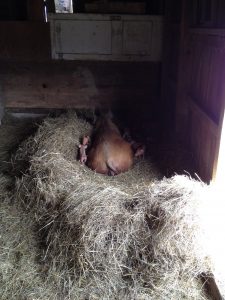
Gertie’s nest.

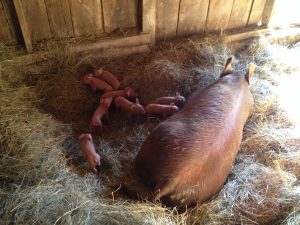
Gertie farrowed right on day 114.  She was sharing a paddock with Flossie and Corky, and 2 days before her due date, we split the paddock so only she could get in the barn.  We cleaned out the barn and added a nice thick layer of hay.  The day before, she would lay on the cool ground and I would rub her belly.  If I stopped, she would give me a grunt.  I could see the babies moving around and knew we were close.  She had also made a HUGE nest of hay and straw.  When she farrows inside the nest, all the babies are contained.  The day of, I checked on her every hour or so, but she wasn’t ready until 9pm.  I came in and saw 1 baby looking for a teat.  I walkie-talkied Fred that it was time and bring the supplies.

When Gertie first farrowed with us, a baby was stuck (hence that baby’s name-Corky) and we gave oxytocin to help push it out. Later I learned that should have been the last resort and manual manipulation was the better course of action. Now we have a supply kit with gloves and lubricant. Since it was cold, we had towels to quickly dry them off.  One after another they were born and once dry, started nursing.  Fred went home and I would radio back with updates…number 7, then 8 and 9, 10, 11, a lag until 13 and 14.  It was a long exciting night for me.

Making sure everyone gets fed.

Baby pigs hit the ground running, literally.  They come out, wriggle out of the sac, and start for the teats.  They may not know where they are going, but they are going!  You can tell they are listening to the sow and siblings to find the food.

Two of the piggies were runts.  They were half the size of the others.  We tried our best to keep them warm and get them nursing, but they didn’t make it.  One just disappeared.  When a baby dies, to keep predators away, the sow will either remove the baby or eat it.  Sometimes, the sow will just eat each baby as it is born.  When I found this out, my anxiety level about the whole thing went through the roof.  I worry about the animals health when everything is going well, this was something I just didn’t want to have to witness.  Thankfully Gertie was a great mom to all 11 babies.

Corky’s nest.

When Corky farrowed her 8 babies, I missed the whole thing.  I KNEW she was close when she went from begging for belly rubs to jumping up and going after me, only to flop back down and grunt for me to rub her more.  She was due on a Sunday, but delivered in the wee hours of Saturday morning.  When Fred went to feed that morning, he came back to report 8 healthy babies all nursing.  I was bummed, but happy all seemed to go well.  The first farrowing can be difficult and some gilts will have what they call “gilt hysteria”.  They basically freak out about farrowing and can either eat or trample all the babies.  We were very lucky she was such a good mom.

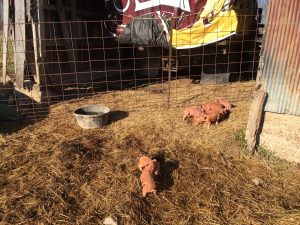
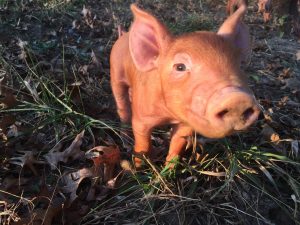
Exploring at 3 days old.

There are a few things we don’t do to babies that other producers do.  Every time you handle a baby, you put yourself and them at risk–sows do NOT like to hear their babies squeal and can charge at you and trample any baby in the path.  Some producers try to breed to have mellow sows so they can handle the babies without issue.  But as far as I can tell, momma protects baby and that’s that.

We don’t give iron shots.  If the babies and mom are on dirt, they can get all the iron they need from that.  The sow will get in the mud, go back to the babies, they latch onto nurse — instant iron boost.

We don’t clip needle teeth.  Those babies have some sharp teeth.  And yes, they scratch each other up and blood on a tail is not uncommon and I am sure all the grunting the sow does is her telling them to knock it off with the teeth already and just suck!  But everyone survives just fine.

We don’t dock tails.  The reason for doing this is so they will not bite off each others tails.  Again, we have had tail biting, but everyone heals up just fine.   With plenty room to move around, I don’t know why they would get aggressive enough to take off a tail.

We don’t ear notch.    A special tool is used to cut a “V” notch in a certain pattern on the outer edge of the ears.  It’s done at about 2 days old, so the blood hasn’t begun to circulate through the outer ear.  The notching system numbers each pig for identification and registering.  To register Tamworths it’s required to ear notch, so we don’t register.

Lunch outside.

We don’t separate to wean until after 10 weeks old.  The babies, and sow, will naturally wean around this time.  Once feed intake has increased, we will separate everyone in adjoining pens for a week or so to let the sow dry up.

We do castrate our male babies.  We both hate this and wish like heck to have as many girls as possible.  Castration is done before 7 days old, usually between 3-5 days.  After 3 days they have had a good dose of colostrum, have the sow’s antibodies in them, and their immune system is kicking in.  Fred holds them upside down, I clean the area and find the testes, make two slits with a sterile blade, pop them out and pull.  Cutting can do more harm than pulling.  When you pull it breaks off at just the right place.  We don’t apply any antiseptic to reduce the stinging and them rubbing the ground.  After a day or two the swelling has gone down and the slots have a nice scab.  In about a week, it will be completely healed.

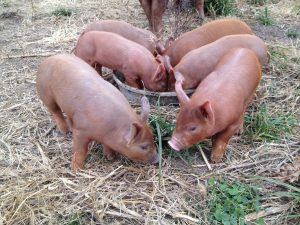
Eating from momma’s pan.

Once a sow farrows, her feed intake increases by 1 pound of feed per piglet on top of their normal ration.  Gertie was getting 16 pounds of feed a day and had the milk production to prove it.  The babies will gain about a pound a day nursing.  The first few days is a lot of sleeping and nursing. By day 3 they are following momma onto the pasture.  They start rooting almost immediately in the nest and nibbling at grass at about a week old.  After a few weeks, the piggies begin to get interested in momma’s feed and they slowly start to eat their own ration until they are not interested in nursing.

Happy piglets!

Unlike Gertie’s previous litter of 3, her new babies wanted nothing to do with me.  As much as I tried to befriend them, it just wasn’t happening beyond an occasional belly rub or ear scratching.  I missed all the loving I could give Shooter and Corky–getting them to flop over with legs in the air for belly rubs or snuggling next to them in the hut.  These new babies would let me scratch on them, realize what was happening, snap out of it, and run away.  During feedings I would get as many scratches in as I could.  They weren’t unfriendly or skittish, they just didn’t want to be snuggle buddies.  So all this time from farrowing to 7 months, I do my best to make sure they are getting as much attention as they will allow me to give.  In that time, whether they feel the same or not, I become attached to them.  I love that the one with big jowls like his dad will let me scratch him only when no one else is watching.  I love calling them through the woods and having them follow me.  I love the time after feeding when they all just lounge around and one will come over to sniff at me and plop down a few feet away.

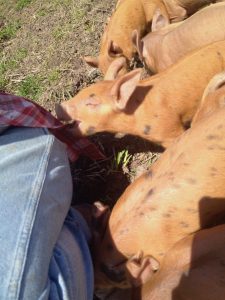
Corky’s babies were a little more interested in me.  I would go in twice a day while Corky ate and give them rubs and talk to them.  One girl would always come and lay next to me while I scratched her.  Now when I come to see them, everyone runs up and all around me trying to figure out the best way to eat my boot or pant leg.  And one by one, I start to rub their bellies and they start dropping like flies with big smiles on their faces.  And just like with Gertie’s litter, I am attached to them.  After all, the reason we spend so much time and effort in how we raise them is so they will have a good life and that includes being loved. 


Next…Part 3–The Piggies Go To Market.

Filed Under: Our Animals, Pigs Tagged With: pigs

  • 1
  • 2
  • Next Page »

Welcome to Stuart Farm!

We’re Serena and Fred Stuart. While raising healthy and happy animals is our #1 goal, we’re also here to serve you! If you’re looking for help in navigating healthy eating and living, you are in the right place! We’re here to answer your questions and help you feed your family meat and eggs you can feel good about. We share farm stories that gives you a peek into our life, recipes to try, health tips, and more. We hope you enjoy coming along on our farm adventures.

Connect with us

  • View StuartFarmLLC’s profile on Facebook
  • View stuart_farm’s profile on Instagram

Contact Us

573-764-2324 please leave a message .
Farm hours are by appointment only.

Tags

Beef recipes broth chickens delivery Devons Dorkings Eggs Farm Life Freedom Rangers garden lard pigs Pyrs raw diet recipes recipes sweets Silver Fox Rabbits Sugaring

Categories

  • Blog Posts (73)
    • Farm Life (39)
    • Mother Nature (1)
    • Our Animals (24)
    • Our Garden (2)
    • Pigs (5)
    • Projects (1)
    • Recipes (16)

Recent

  • 2025-2026 Our Years of Transition
  • Our Farmstay Is Now Open!
  • The Best Way to Take Charge of Your Health
  • Love is…
  • My Summer Reading List

Archives

Copyright © 2026 · Focus Pro Theme on Genesis Framework · WordPress · Log in

Loading Comments...