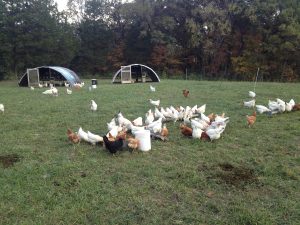
Stuart Farm

  • Our Story
  • Shop
    • Our Store
    • Where to Buy
  • Come Enjoy a Farm Stay!
  • Our Classes
  • Fertrell Products
  • Contact Us
  • Blog Posts
    • Our Animals
    • Mother Nature
    • Our Garden
    • Recipes
    • Farm Life
    • Projects
  • Consultation Services
  • 0 items

3 of My Favorite Books You Need to Read Now

Posted on November 14, 2018 Written by Serena 6 Comments

I was never a big book at the beach reader. Sure, I’d bring one and get through a few pages, but people watching would always win out.

Now, curl up on the couch by the wood stove in winter to read?  You bet!

Although I don’t make as much time as I used to for fun reading, I do have my favorites.
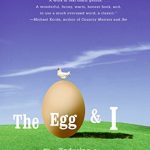
The Egg and I; Betty MacDonald

Fred’s cousins Diane and Steve gave us this book for a wedding gift.  I had never heard of it, but once I started reading it, I couldn’t put it down.   We married in the Fall, so over the winter I would read it aloud to Fred before bed. Talk about the perfect book for us!

It’s the memoir of Betty MacDonald, who marries a would be chicken farmer (sound familiar?) and the life that ensues.  The book starts with some background of Betty’s childhood and her mother’s advice that a wife always supports her husband’s ventures.  So when Bob decides to leave his office job and become a chicken farmer, Betty is right by his side.

Betty tells her tales of hauling water, trying to master a temperamental wood stove, life on the Olympic Peninsula in Washington state, dealing with neighbors and Native Americans, the beauty and hardship that is life on the farm, and the experience of a first time chicken farmer.

Having never raised chicks before meeting Fred, I love her description of brooding chicks, the time and effort it takes, and feeling consumed by tending to their every need.  If you want a peek into our farm life, read this book!
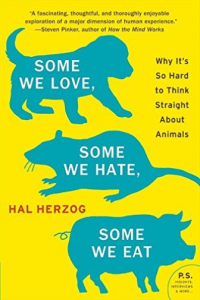
Some We Love, Some We Hate, Some We Eat; Hal Herzog

I found this book at our local library, so maybe you can, too.  Whenever I have someone ask how we can kill an animal we raised with so much care, I recommend this book.

Herzog, is an anthrozoologist (science of human–animal relations) and he delves into why we view some animals as pets, others as food, and some as disgusting creatures.

For over two decades he has tried to answer questions about human and animal interactions like does having a pet really make you happier?  Why does one culture view a dog as a family member, while another sees it as food, and another shuns them?  What do people really mean when they identify themselves as a vegetarian? Who has the better life–a chicken in a factory farm or a rooster raise for cockfighting? What can we really learn from experiments on mice?

This book will open your eyes as to why you think what you do about the animals around us.
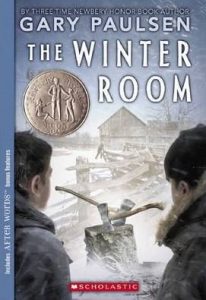
The Winter Room; Gary Paulsen

I found this book on a “free” cart at the library.  What a score!

The book begins in the Spring, with eleven year old Eldon narrating through the seasons on the farm.  From animal birthing to summer harvests, from fall butchering to time in the winter room. The winter room is where the two brothers gather with their family on cold nights to hear stories from old Uncle David.  One night, the boys tell their uncle they don’t believe his story, so the stories stop.  Only after the boys spy on their uncle, do they believe him and beg him to resume story telling.

As a child, I spent a lot of time with aunts and uncles and our grandmother lived with us for awhile.  So the idea of having family around and sharing so much, really struck a chord with me. Paulsen delivers the perfect picture of farm life of both children and adults.

All of these books can be found on Amazon and Ebay, and hopefully your local library.  If you read one, let me know what you think in the comments!
Filed Under: Farm Life

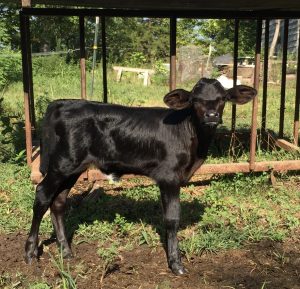
The Story of Sasha, the Bottle Calf

Posted on July 29, 2018 Written by Serena 4 Comments

After a full day of chores and butchering our last 27 (of 400) meat chickens, I was daydreaming about what I would do with my new found 2 free hours a day. Then there was a familiar knock at the door.
What was my Old Timer doing here so late?

He told us about a cow he was tending to with a week old calf that was not doing well.  She was his partners, but he tends to the day-to-day management of the cattle.  The cow had 2 previous calves that did not survive, and if this one didn’t get on the bottle, that would be her fate as well.

He explained that she had a full bag and would allow the calf to nurse, but the milk was bad.  The calf wasn’t getting any nutrients.  He didn’t have time to bottle feed right now, and if he couldn’t find anyone to take her…

Well, there went my new found 2 hours of free time.

The next morning, we loaded up a crate and went to get the calf.

We headed out to the pasture and found the pair.  The calf was skinny but bright eyed.  We cut in between the two and Fred scooped up the calf, jumped in the back of the gator, and we took off.  The cow followed us a bit and I jumped out to close the fence just in time.

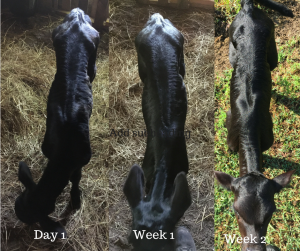
We got her in the crate and looked her over.  She was skinny, showing her spine and ribs, but not dehydrated.  Her ears hung a bit, but her eyes were clear.  Then we found maggots on her anus.  Old Timer sprayed it with some worm spray to kill them until we could get her washed off.

Old Timer tells me not to name her until we’ve had her a week.  My reply? “Well Sasha, isn’t that the silliest thing you’ve ever heard?! ”  He and Fred groaned.

At home, I washed her backside and thankfully that took care of that.  The maggots were less than 12 hours old, so we got her just in time.  I mixed up a cup of formula for her and got ready for a fight.  The last time we had a bottle calf, he didn’t want anything to do with the bottle–he wanted his momma!  Sasha was hungry and took to the bottle instantly.  Whew!

We moved her into a barn stall next to Trudy and the piglets.  Until she was eating well and having normal poops, it was better to have her on her own.

She hadn’t had any nutrients in her system, so we started her slowly on feed.  Usually, bottle calves start with 1 quart of milk two times a day.  Sasha started out with 1 cup four times a day.  She wasn’t too happy about it–she wanted to eat!  The next day another cup was added, and another the next day, until she was up to 2 quarts split into four feedings a day.  Starting her too fast could have lead to diarrhea, which is another whole issue to deal with.

When you read up on bottle feeding, they talk about proper positioning of the bottle, amounts to feed, weaning, and such.  They sometimes talk about leaving right after feeding because the calf will want to eat and chase you around, sometimes head butting you.  Yes, Sasha did this.  She sucked on my arm, pant leg, boot, whatever she could get a hold of.  And she would but me with her head, sometimes in my crotch.  It’s not that annoying or painful, so I’d stick around and play momma.

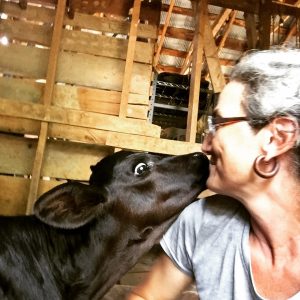
While I can’t, and don’t, lick the calf as her momma would, I do what I can to help groom her.  She gets rubbed down from head to toe–literally.  It’s not as good as a momma licking, but it helps to stimulate circulation and digestion.  The other benefit is getting her used to being handled.  When you have a sick or injured animal, the easier it is to handle them, the easier your life will be.

Being affectionate or trying to suck my face like a bottle?

Her first full week went well.  During feedings, I would wipe down her backside to get any poop off to keep flies to a minimum.  This is something her momma would do as it also stimulates pooping.

After week one, Sasha had normal poops, so I moved her in with the herd.  On a day I was home all day, I did her morning feeding with the herd.  After she ate, all was well as she cautiously inspected everyone.   I watched for half an hour and decided she was ok.  When I checked back in an hour, she was gone.

Being a baby still, I knew she would search out tall grass to hide in.  And since I left the fence up from when the other calves would go in the tall grass, Sasha made her way there.  Once she saw the bottle, it was easy to get her back in and lower the fence.

Slowly but surely, she began to put on weight and gain more strength.  She slowly moved closer to the herd and followed them out to the pasture.  June Bug and George still weren’t too friendly with her, but they tolerated her well.

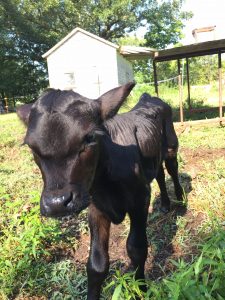
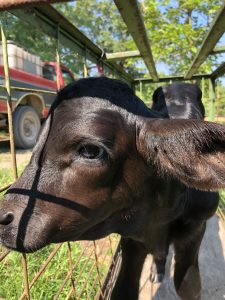
At week two, she was looking ready to find a new home.  I would’ve loved to keep her, but we are right where we want to be with our herd as far as breeders.  With a face like this…

…it didn’t take long for someone to fall in love with her.

Sasha is off to her new home with a new brother to keep company.  Thanks for coming into my life little girl; you will be missed.  Now to enjoy my new found 2 hours of “free time” a day until the new chicks come in 3 days.

Filed Under: Farm Life, Our Animals

How to Improve Your Eating Habits Right Now

Posted on July 26, 2018 Written by Serena 2 Comments

Most of us have at least one throw down meal we make.  You know, what you cook when you just don’t have time to cook a “real” meal. For us it’s usually eggs.  But eggs twice a day can get boring, so we keep a couple of packs of frozen raviolis on hand.

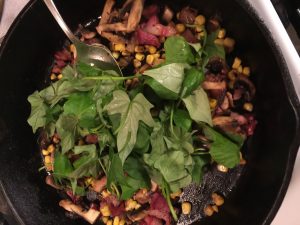
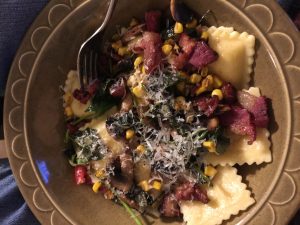
Yes, contrary to popular belief, we don’t always eat the healthiest.  But, that’s ok. One thing I do with our throw down meal is make sure there’s at least some farm raised additions.  After putting up about 200 square bales the other night and preparing dinner at 9:30pm, Fred said, “make eggs”.  Instead, I made frozen raviolis topped with bacon ends, sautéed mushrooms, corn, sweet potato greens, tomatoes, and parmesan.  Sooooo much better than scrambled eggs and it took the same amount of time to make it. 

So how do you go from eating a quick bowl of cereal or making a drive-thru run to a healthy meal?

When you’re changing your eating habits, I find these two things make it a bit easier:

1-find a baby step and start there.

2-don’t beat yourself up when you misstep.

When people ask me how to eat better, the first thing I tell them is to determine what’s most important to them and take that baby step.

Is it eating organic? Non-GMO? Humanely raised meats? Free range eggs? Pasture raised meat?

Eating more greens? Eating fruit and veg when it’s in season?  Buying locally grown produce?

Eliminating certain canned or processed foods?

Pick one thing and work on that. It doesn’t have to be all or nothing.  That’s how we end up not making any real or lasting changes–trying to do too much at once.

That’s where number two comes in–don’t beat yourself up when you don’t stick to the baby step.  If you are going out to dinner or eating at someone else’s house, you don’t have to stick to it. And you don’t have to feel bad about it. Giving yourself the freedom to be okay with slacking a bit will actually help you stay more on track.

When we first started changing our eating habits, we started simple…no canned foods.  We are both BIG Rotel fans, so that was the hardest until I started canning my own.  We go through about 2 gallons of Rotel a year, so I make sure I can that every summer now.  Then we went to only sugary treats that we made were allowed (chocolate chips were the exception).  We went a bit crazy at first, then slowly we started to taper off the cakes, cookies, and brownies.  Mainly because it was a lot of work.

After logging everything we bought at the grocery store for 1 year, we started to wean off the chocolate chips.  Because seriously, buying 56 bags of chocolate chips a year just seems a bit much.  We went to 2 bags a month for a while, and now we I don’t buy them.

We try to eat less flour based products and I’ve switched to sprouted grain breads.  We cut out the pretzels at lunch, but do have crackers on hand for snacks.

What I have found with all these small changes is my taste for certain things has changed.  Sweets are sooooooo much sweeter to me.  And too many corn tortillas do not sit well in my belly.  And when I eat sweets at a family dinner or can’t resist my popcorn craving, the one thing I don’t do is beat myself up for it.  I know what my baby steps are, and even years into it, I still consider them baby steps.  Beating myself up for backsliding only makes it easier to say forget it all; and I don’t want to do that.

Before you start on the latest fad diet, think about what you really want to accomplish with your eating habits. The fad diet won’t stick around long, but what you make a habit will.

So what’s your baby step?  Share it in the comments.

Filed Under: Farm Life

Everything You Ever Wanted to Know About Eggs

Posted on June 5, 2018 Written by Serena 8 Comments

When I first started raising chickens, I read everything I could and asked everyone I knew who had chickens a million questions.  Chickens are such fascinating and strange little creatures! So it’s no wonder we get questions about eggs, and the girls who lay them, more than any other topic.  Here are your most asked questions.
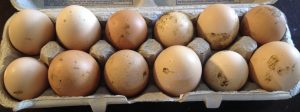
Why are some yolks yellow and others orange?

It all comes down to diet.  Our girls are moved through the pastures year round.  So while they are on grass at all times, the eggs they produce can look different.  In the spring, they are eating lush green grass/clover and this can make the yolks VERY orange.  I say “can” because not all hens eat the same amount of greens.  Some hens forego the feeder for fresh grass, some are just the opposite, so the color of yolk will vary.  When the grass isn’t as plentiful and fresh like in winter, the yolks will be more yellow.  To get around this, some feeds add in marigold extract and have a lot of corn to help make yolks more orange. We let our girls and the seasons decide the color of their yolks, not feed additives.

Should I store my eggs in the fridge or on the counter?

This is a personal choice and really depends on from whom you buy your eggs.  Once an egg has been refrigerated, they should stay refrigerated.  When condensation accumulates on the shell from a temperature fluctuation, you risk any bacteria on the shell getting sucked into the shell. Shells have pores that expand or contract with temperature changes.  If you buy from a farmer who doesn’t refrigerate their eggs, you can put them in the fridge or keep them on the counter.  If you want to keep them on the counter, you should ask your farmer if they wash their eggs (more on that in a minute). After 7-10 days on the counter, the eggs will begin to lose quality; whites will spread more, yolks won’t be as high.  It takes a long time for an egg to go rotten, so no worries there, but…

How do I know if an egg is bad?

It takes a lot for an egg to become rotten.  We are talking a couple of months outside in the sun.  They can lose quality if not properly stored, but the eggs you have in your fridge, very doubtful they will become rotten. Loss of quality is measured by the height of the yolk and the spread of the whites.  If an egg has a flattened yolk, or whites that run, it could be that it’s an older egg, or it could be because it was laid by an older hen.

To test if an egg is laid within a week, simply placed it in a glass of water.   An egg that stays on the bottom is less than 7 to 10 days old.  An egg that leans up or stands on end is about 10-14 days old. The egg floats because the air sac in the egg expands acting as an air bladder. The older the egg, the larger the air sac, the more it floats.  Thinned shelled eggs will get a larger air sac faster.

Should I wash my eggs?

This again is a personal choice.  Store bought eggs are required to be washed, coated, and sanitized before sale.  Depending on the state you are in and whom you are buying from, your eggs may be unwashed.  We are not required to and we don’t wash our eggs.  Because our eggs are not washed, they have the natural coating, or bloom, that helps keep any bacteria from entering the shell and preserves their quality. If you want to wash our eggs, do so right before cracking and with warm running water for no more than 5 seconds.

Eggs after a rainy few days. We would never wash these and sell them

Washing eggs is done to clean off dirt and manure.  We check our nest boxes regularly throughout the day and make sure nest pads are not soiled.  Sometimes an egg will crack, a chicken will sleep and poop in a nest box, or the girls have cow manure on their feet when they go to lay.  We do not sell these eggs to customers.  If there is dirt that can be flicked away with a swipe of sandpaper, that’s fine.  Otherwise, we eat the dirty eggs.

To keep the eggs from absorbing anything into the shell, the washing water must be maintained between 90-120F.  While some egg washes say to leave the eggs soaking for 5-10 minutes, this can increase the risk of contamination and is best avoided. I have heard of people cleaning eggs with a Magic Eraser; please do not do this.  I’m not sure what’s in the eraser, but I am pretty sure you don’t want it touching your food.

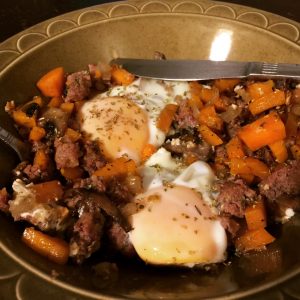
Sweet potato and sausage hash with “poached” eggs makes a great lunch, dinner, or snack.

Are your eggs more nutritious than store bought?

We haven’t had our eggs tested for nutrient content, but I can say this: if you are what you eat, you want to eat our eggs!  There was a study done comparing the nutrient content of pasture raised eggs to conventional eggs.  Overall, pasture raised eggs have 2/3 more Vitamin A, 2 time more omega-3 fatty acids, 3 times more Vitamin E, and 7 time more beta carotene than conventional raised eggs.  It also states they have 1/3 less cholesterol and 1/4 less saturated fat.  So if you want a snack you can feel good about eating, try an egg.

Do you have to have a rooster to get an egg?

A hen will lay an egg without a rooster.  A rooster is needed if you want fertilized eggs to hatch chicks of your own.  We keep at least one rooster to act as the flock protector.  A rooster will sacrifice himself for the safety of his girls.  He also finds food and calls over his girls to make sure they don’t miss out on a tasty morsel.

Do you give your hens antibiotics or hormones?

No and No.  If we have a sick or injured hen, they get plenty of TLC and rest in a hospital cage in the house.  I mix up special feed with herbs, coconut oil, and kombucha.  If the bird has a cut, it is tended to with coconut oil. Our flock has never been, nor needed to be, treated with antibiotics.

Hormone have not been allowed for layers or meat birds since the 1950s.  So the claim “hormone-free” really doesn’t mean much.  All eggs and chicken are hormone free.

How is pasture raised different from cage-free or free range?

Cage free and free range are regulated by the USDA, pasture raised is not.  Cage free means just that, they are not in a cage.  But they may be in a barn and never step outside, and there is no standard for how much space each bird should have.  If cage free eggs are humane certified, there are spacing standards; usually about 1.5 sq ft per bird. That means in a 12’x12′ space, you can have 96 hens.

Free range means different things depending on whom you buy your eggs from.  In large commercial production, the birds have access to the outdoors, but they may not actually ever go outdoors. They just have to have the ability to go out if the choose. Most access doors are small and the birds never find them or are too scared to go through them.  The doors will lead to an outside area, that may be a screened in porch and usually not all birds will fit outside at once. If the eggs are free range and certified humane, there is a spacing standards of about 2 sq ft of outdoor space per bird. That 12’x12′ space would have 72 hens. If you buy from a small producer, it’s more likely the birds are roaming the farm, going where they wish (sometimes much to the farmers chagrin). Asking your farmer what they mean by free-range and how they protect the flock from predators is a good idea.

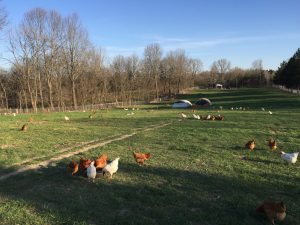
Pasture raised is basically one of two set-ups. The chickens stay in a coop on pasture and don’t roam much or they are in an electric netting area, they can roam that area, and the coop is moved every couple days.  Most producer we know who have pasture raised eggs allow the birds to roam in a netted area for predator protection. Our girls are in a netted area of about half an acre to over an acre (comes out to 174 sq. ft. per hen in a half acre area).  Their layer wagon is moved within each area and is left open so they can go out as early and eat as late as they want.

I buy organic eggs, those are better, right?

Yes and no.  If organic chicken feed wasn’t so expensive and didn’t come for another state, we would feed it.  We have chosen to buy our grains locally, so right now non-GMO is our best option.  The organic label has more to do with what the hen ate, than living conditions.  As with cage free, organic hens must only have access to the outdoors, not living on pasture. So if you are opting for organic, you are not necessarily getting pasture raised eggs.

When will a chicken lay an egg?

Pullets, or chickens who haven’t started laying, can lay their first egg at 5-6 months old depending on the breed. Spring is when egg production picks up. Longer daylight hours signals the girls it’s time to start laying more, and in some cases, try to hatch a clutch of eggs.  They begin with pullet, or beginner, eggs. These eggs have the same nutrients and taste as larger eggs, just smaller.  Pullet eggs come in all shades of brown, some have spots, some come out almost spherical.  It’s interesting to see what they come up with while they figure out their new talent.

A hen can lay an egg every 24-36 hours at peak production.  Once Fall comes and the daylight hours shorten, production will drop and they begin to molt.  During molt, they will lose a lot of feathers and put more energy into growing new ones to have fresh feathers to keep them warm through the winter. Some producers get around the drop in production by adding supplemental light in the coop to make the hens think it is Spring.  Not having this natural break puts added stress on the hens system.  We don’t use supplemental lighting.

What should I ask a farmer about their eggs to make sure I am getting what I want?

I want you to get exactly what you want and what you are paying for.  I don’t want you to be fooled by buzz words like “hormone-free”; I want you asking questions.  With the knowledge you have gained from this post, you should be able to ask these questions and make an informed choice about where you buy your eggs.

  • What do you feed your hens?
  • How big of a space are they in?
  • How much access do they have to grass and roaming?
  • Have your eggs been refrigerated?
  • Do you wash your eggs and what’s the process you use?
  • Do you use extra lighting in the winter?
  • Can I visit your farm?

Questions should be welcomed by the farmer.  If not, you may want to reconsider buying your eggs from them.

Have another egg question? Let me know in the comments.

Ready to grab a couple of dozen to enjoy? Click here!

Filed Under: Farm Life Tagged With: Eggs

  • « Previous Page
  • 1
  • …
  • 6
  • 7
  • 8
  • 9
  • 10
  • Next Page »

Welcome to Stuart Farm!

We’re Serena and Fred Stuart. While raising healthy and happy animals is our #1 goal, we’re also here to serve you! If you’re looking for help in navigating healthy eating and living, you are in the right place! We’re here to answer your questions and help you feed your family meat and eggs you can feel good about. We share farm stories that gives you a peek into our life, recipes to try, health tips, and more. We hope you enjoy coming along on our farm adventures.

Connect with us

  • View StuartFarmLLC’s profile on Facebook
  • View stuart_farm’s profile on Instagram

Contact Us

573-764-2324 please leave a message .
Farm hours are by appointment only.

Tags

Beef recipes broth chickens delivery Devons Dorkings Eggs Farm Life Freedom Rangers garden lard pigs Pyrs raw diet recipes recipes sweets Silver Fox Rabbits Sugaring

Categories

  • Blog Posts (73)
    • Farm Life (39)
    • Mother Nature (1)
    • Our Animals (24)
    • Our Garden (2)
    • Pigs (5)
    • Projects (1)
    • Recipes (16)

Recent

  • 2025-2026 Our Years of Transition
  • Our Farmstay Is Now Open!
  • The Best Way to Take Charge of Your Health
  • Love is…
  • My Summer Reading List

Archives

Copyright © 2026 · Focus Pro Theme on Genesis Framework · WordPress · Log in

Loading Comments...