Stuart Farm

  • Our Story
  • Shop
    • Our Store
    • Where to Buy
  • Come Enjoy a Farm Stay!
  • Our Classes
  • Fertrell Products
  • Contact Us
  • Blog Posts
    • Our Animals
    • Mother Nature
    • Our Garden
    • Recipes
    • Farm Life
    • Projects
  • Consultation Services
  • 0 items

On Death, Dying, and Killing

Posted on April 25, 2013 Written by Serena 3 Comments

After I wrote my post about Agnes the rooster getting killed, my Dad asked that I not post anymore sad stories. That’s a hard request to honor. As much as beauty, wonder, and magic are part of the farm, so is death, dying, and killing. Every day, and I mean EVERY SINGLE DAY, I am in total and complete awe of something. We don’t have to STOP to smell the roses, we can enjoy them every day, all day. Whether it’s the wild violet popping up to announce spring, the snow clinging to the trees like a white shadow, the lightning bugs continuing the starry night into the trees and pastures, or walking the fence line enjoying the silence…there are so many things to soak in and appreciate. But for every good, there must be a bad.

Something we hear a lot from people is, “I would love to raise my own food, but I couldn’t kill an animal”. My answer is always that it is one of the hardest parts of what we do. The hardest part would be finding an animal dead or having to euthanize it. Yes, death is death. But there is something about an animal that doesn’t get to fulfill its purpose that makes me very sad. We’ve had chicks that just die. We had a calf, Caroline, that was lame and when we couldn’t get her to stand, we had to euthanize her. Then there are the cases where being a responsible owner mean you make the choice that is best for the animal. Fred’s horse, Honey, was very old and sick and we couldn’t stand to see her suffer through the summer heat, so we put her down. We butchered 200+ chickens last season and every one was hard. With each one, we say, “I am sorry”. The night before, Fred and I always have knots in our stomachs. One reason our business stays small is that we do all the butchering here on the farm. There is a place about an hour away that we could take them to be processed, but we just can’t bring ourselves to do that. Part of why we do what we do is so we know how the animal is treated. After caring for them, singing to them, giving them a good life, I can’t see us piling them into a trailer and driving them to their death. This May, we send two steer to be butchered. If we were set up better, we would do the slaughter on the farm and take them in to be only processed. I feel like if anyone is going to do the killing, it should be us, not a stranger.

I heard a story about a woman who asked a person who raised their chickens to eat, why they couldn’t just get their chicken from the store like everyone else. Let that soak in for a minute. I think most people are just as out of touch with where their food comes from as what it means to raise your own food. Yes, I have killed chickens. To eat and to stop their suffering. It’s not easy. But I think one of the ways I am able to do this is because I have raised them. I see chicken and beef in a store, and I think, “no one loved that animal”, “no one tossed and turned at night wondering if they were ok”. Seems odd to think that caring for them enables me to kill them. But knowing how they lived, and the compassion given at their death, does make it bearable.

The other day I came across a rabbit nest while we were putting up the pig pen. One of the small dogs was in the pen, and I noticed she had something in her mouth. I looked closer and thought it was a vole. Then, I noticed 4 little rabbits in a nest. My heart jumped. I checked them and they were all dead. I am afraid that when we came into that part of the pasture, it scared the mother off, and they died because of us. It was hard to see them all dead. Part of me had hoped I could have raised them…had my own litter of bunnies. In the end, they would have had the same fate, but at least if I had raised them, they would have been safe and lived a good life.

It’s the circle of life, the way it goes, and we all have our place in the food chain. But I think it’s how we face death and what we do before it that makes the difference. With people and with animals. So we try to make our life and our animals life the best it can be.

Filed Under: Farm Life Tagged With: Farm Life

Sugaring…or How we Make Our Maple Syrup

Posted on April 24, 2013 Written by Serena 1 Comment

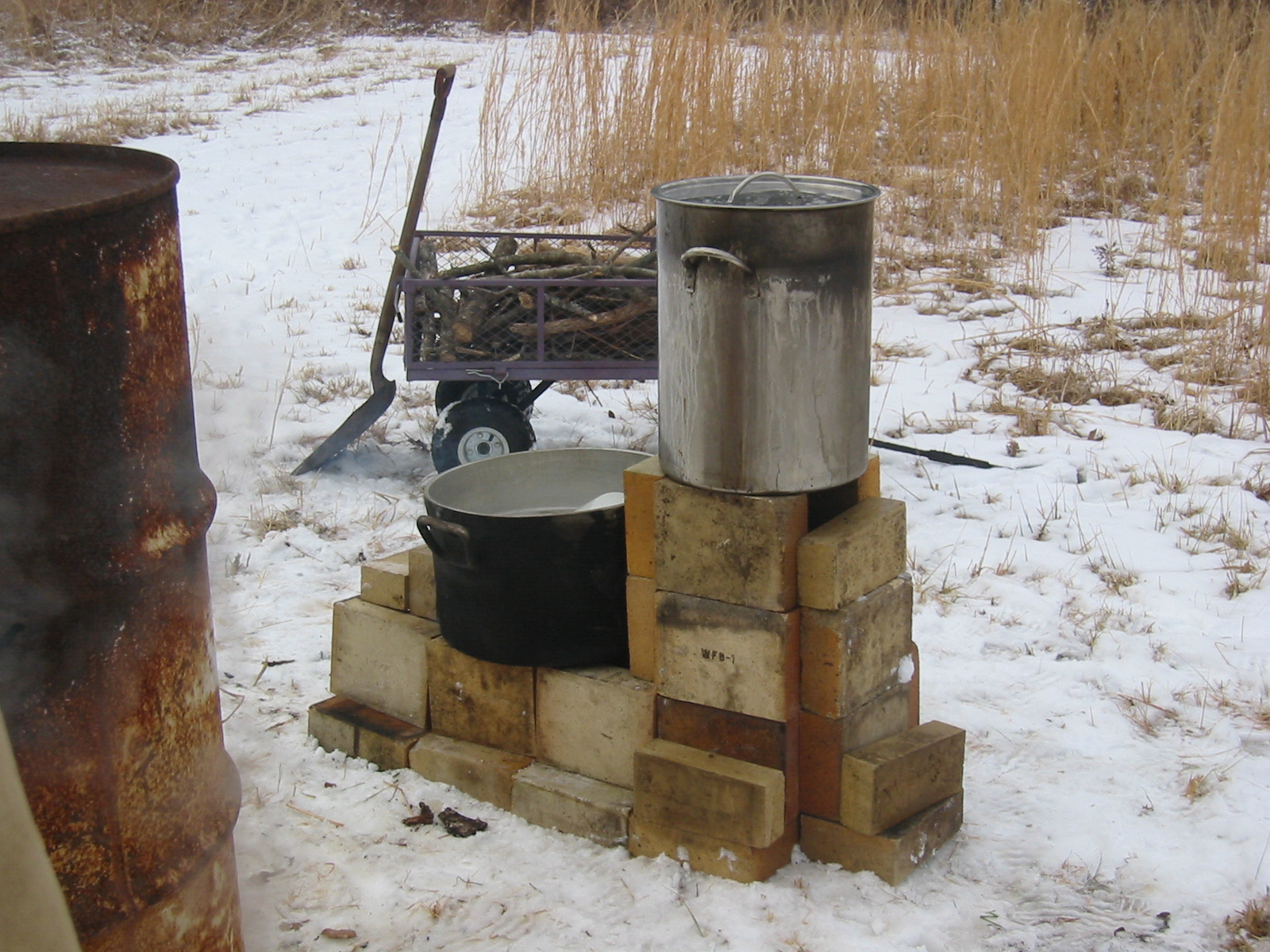
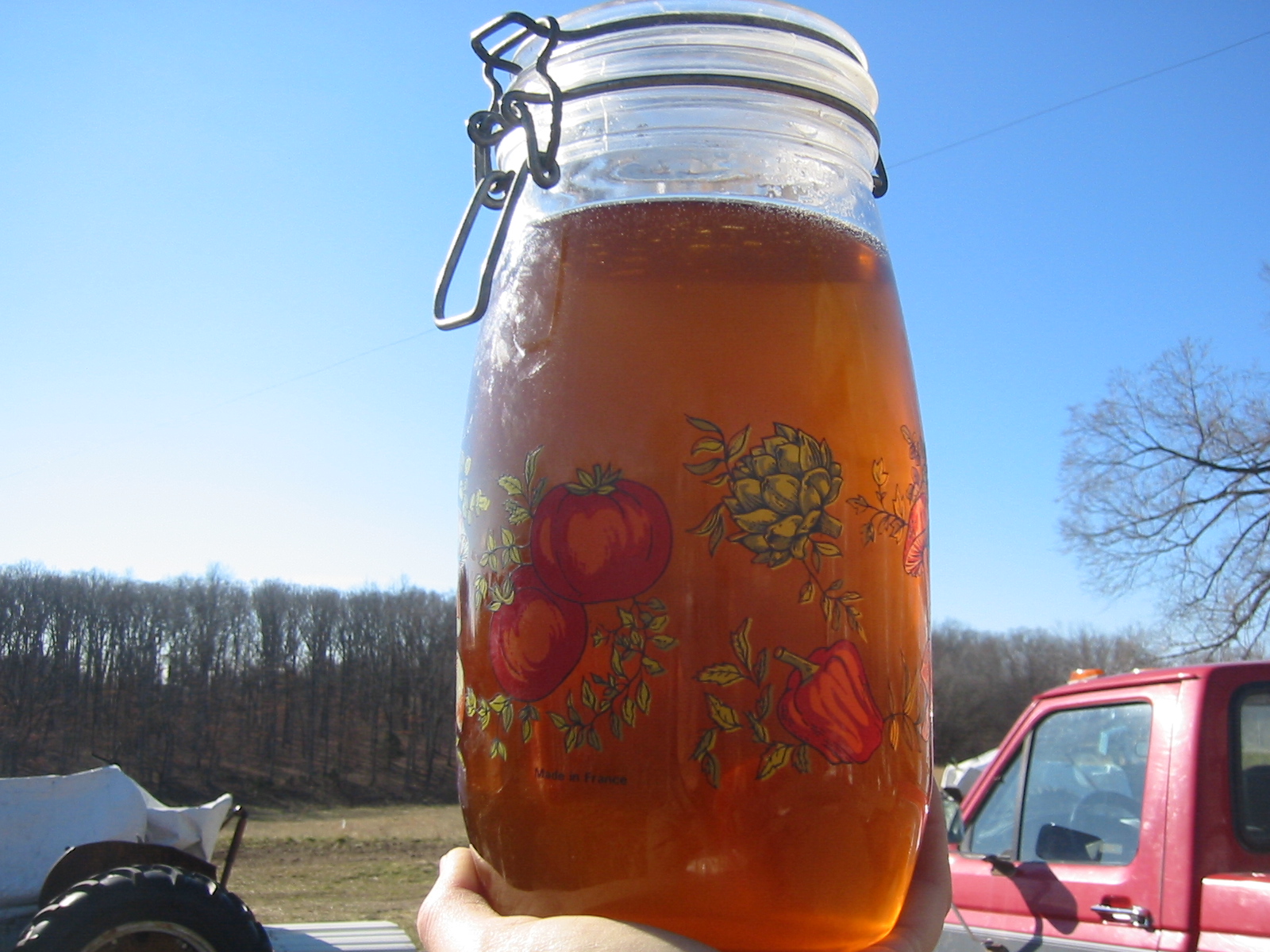
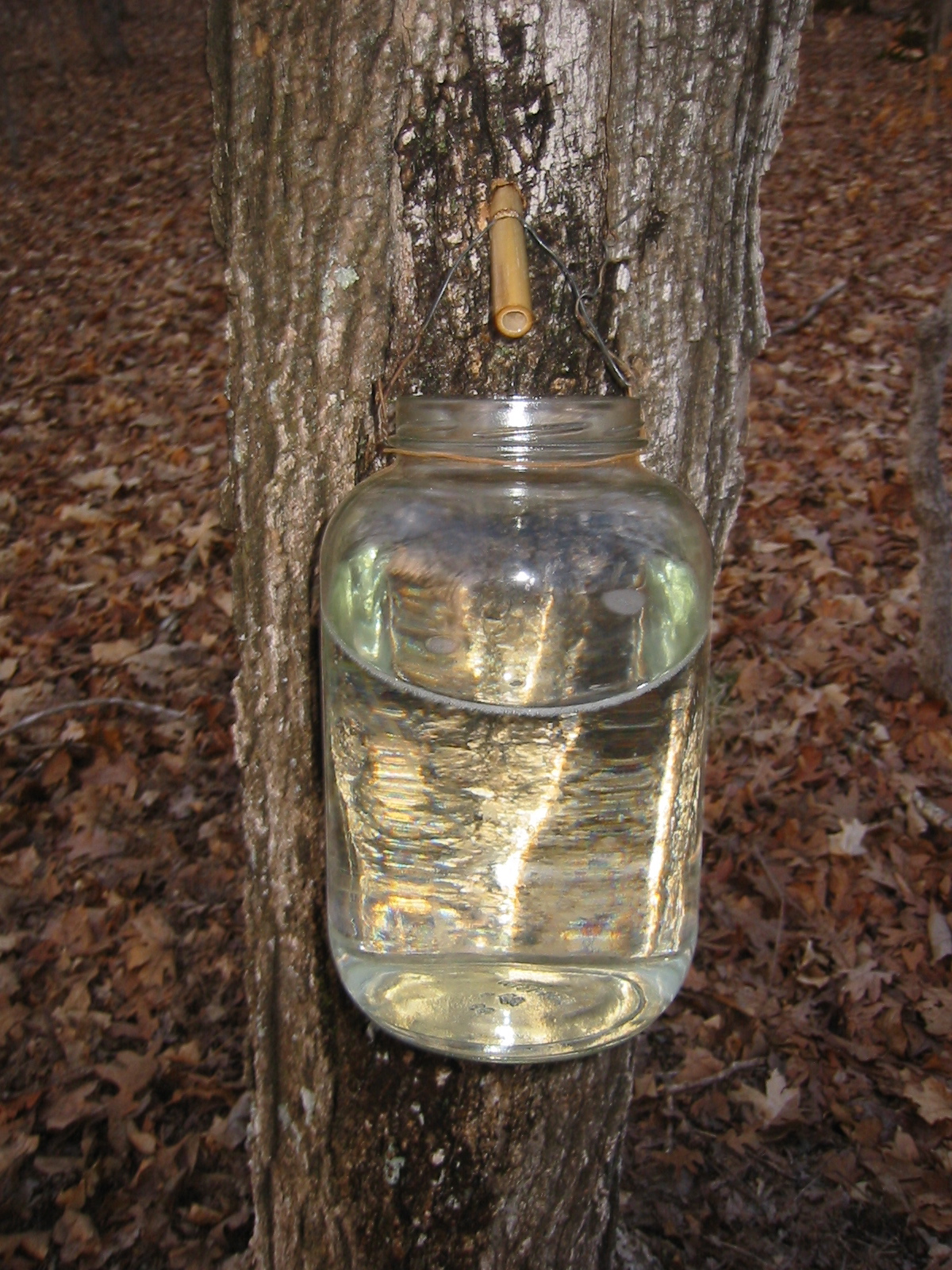
Tapping the treesSap Boiling down Light amber maple syrup

Like a lot of what we do here on the farm, making our own maple syrup is a labor of love. That is not an understatement. Sugaring, as it is called, is a lot of work and time. Collecting the sap, sometimes twice a day, and carrying it through the woods is hard. Boiling it down can take 2 days and I must tend to the fire and sap every half hour. Thankfully, tapping is done during a time when there isn’t a lot of pressing tasks to be done around the farm. And since I am the one who has to brave the grocery stores, I like to come up with lots of ideas of what we can make ourselves and reasons we don’t need to buy them. Most of those ideas you can read about in other posts. So when we found lots of Sugar Maples on the farm, it seemed only fitting to start making our own syrup. And I won’t lie, I love some homemade waffles. And using our own syrup just made me love them more. My first winter here was perfect for making maple syrup. We had lots of snow, so keeping the sap cold was easy…pack it in snow. Not all years are so easy. This is our second time making syrup, but we have a new fridge to keep the sap cold until boiling. Our first year we tapped 5 trees and collected enough sap to make about 1 gallon of syrup. This year, we tapped 18 trees and are hoping for a good harvest.

Sugar maples have the highest sugar content of the maples. You can tap other maples, but you will have to collect a lot more sap. To tap a tree, it must be at least 10 inches in diameter (31 inches circumference). This ensures the tree can not only produce a good flow, but also can recover from tapping. A tap is 7/16 inches diameter and about 2 inches deep. That is a lot of damage to repair and if the tree is not old enough or healthy enough, it can do unrepairable damage. To get a good flow, the day time temp must be over 40 F and sunny and drop to or below freezing at night. Most trees can give up to half a gallon of sap a day. To make one gallon of syrup, you will have to collect 40 gallons of sap.

Last summer I tagged all the sugar maples that looked big enough to tap. That made locating the trees this winter much easier. I collected all the tools I would need…a brace (manual hand drill) and auger bits, a sharp saw, the spouts, the jars, a hammer, and a measuring tape. I went through the woods measuring the trees. Ones that were big enough were left tagged, the ones that were too small were re-tagged on the branches. I had made our spouts again this year from our bamboo. I cut a piece between the nodes and cleaned them out. They work very well. I drilled the holes at a slight angle pointed up to help the sap flow. Once the hole is cleaned out, the spout is tapped in just far enough to hold it into place and hold the weight of the jar. A small notch is cut out to hold the wire that holds the jar. Then I wait.

My first full day I collected approximately 8 gallons of sap. Later in the week, I collected less than a gallon. Watching the temperatures is crucial to making sure I collect often enough. One night it was just bellowing freezing and the day time temp was in the 50s–optimal conditions and I collected almost 15 gallons. I waited to long to do my first collecting and some of the 2 quart jars were overflowing. I came back 3 hours later and they were almost full again. I wait until I have at least 20 gallons to boil. That will give me half a gallon of syrup. We have an outside stove set up to boil. Cooking off approximately 19.5 gallons of water is too much condensation to do inside. The wood stove maintains a pretty even temp as long as we keep an eye on it. The first 6 hours are pretty boring. Once you get to about 2 or 3 gallons, you need to keep a good watch on it to make sure it doesn’t boil down too fast. Once it gets to 219F, it is at the optimal sugar content and is canned.

As the month progresses, the resulting syrup should change from a grade A light amber, to a grade A dark amber, to Grade B. The light amber has more of a caramel taste to it. The dark amber is more like what you would get at the store. The grade B is better for cooking since it has a stronger taste, more like a molasses. Our first year, we got what Fred called “black platinum”…a dark amber with a strong maple flavor. This year produced only light amber. And 2 batches were tainted by our new fridge smell and gave the syrup an off taste.

Even though you can find 100% maple syrup in the store, and I don’t mean the Log Cabin type, it isn’t quite the same as what we make. I am not sure why. Ours is not as thick as the store bought syrup. While family and friends like ours, they have become used to the thicker consistency of store bought. Our 2 gallons from this year will last us quite some time. It will go in oatmeal, cereal, baking, tea, coffee, yogurt, and ice cream topping.

Filed Under: Projects Tagged With: Sugaring

Maxie, Our Great Pyrenees

Posted on March 31, 2013 Written by Serena 2 Comments

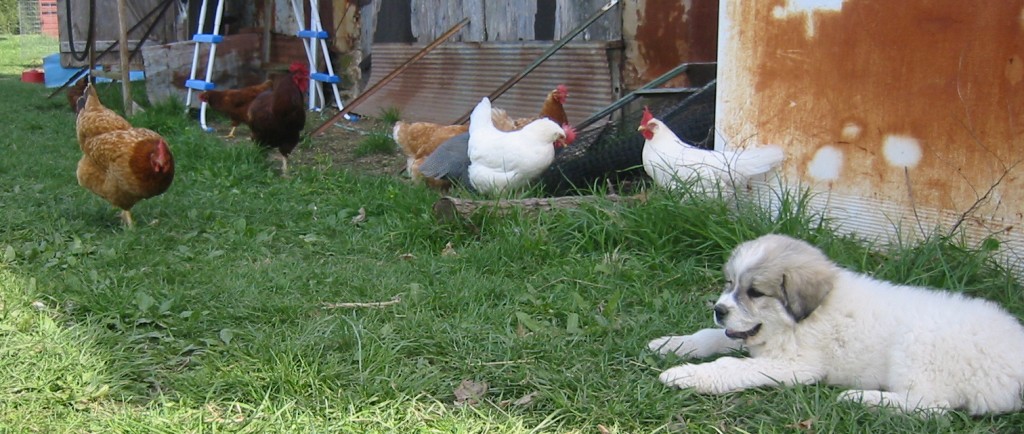
In 2012, we had a massive chicken loss to predators.  We had toyed with the idea of getting a Great Pyr to protect our chickens, and this sealed the deal.  A family member had an accidental litter of Pyrs, but it wasn’t quite the right timing. Raising 3 batches of chickens and a puppy would be a lot of work, but we just couldn’t pass up the opportunity.
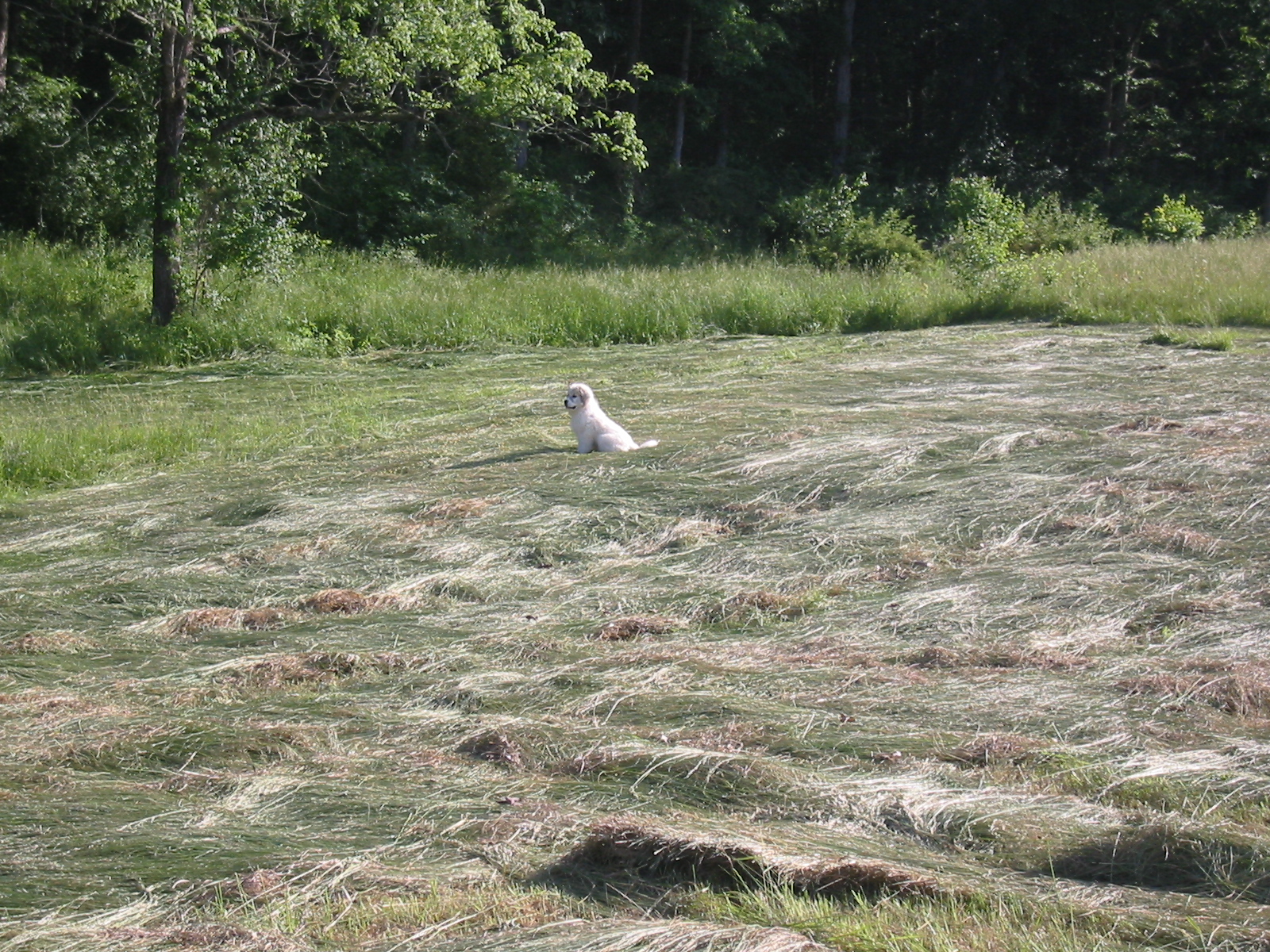
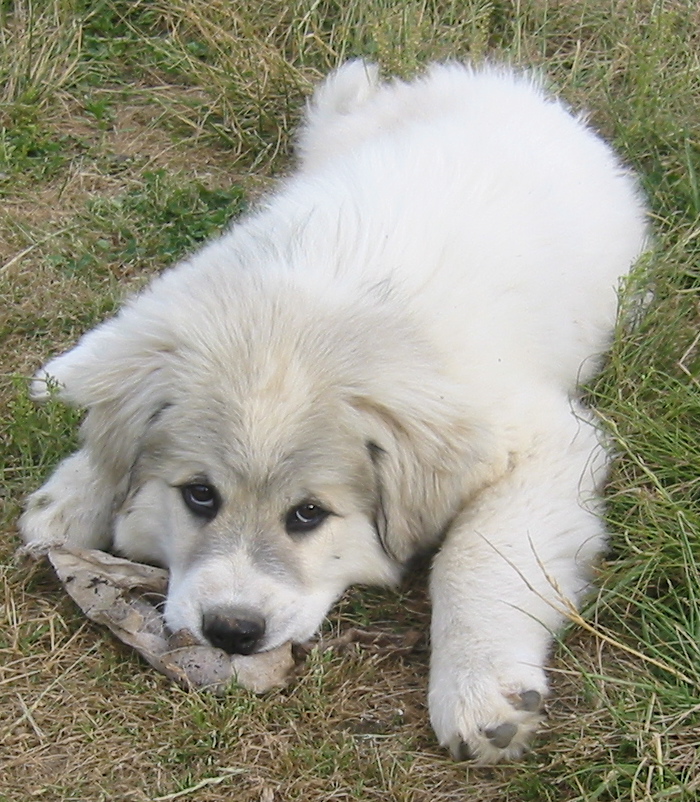
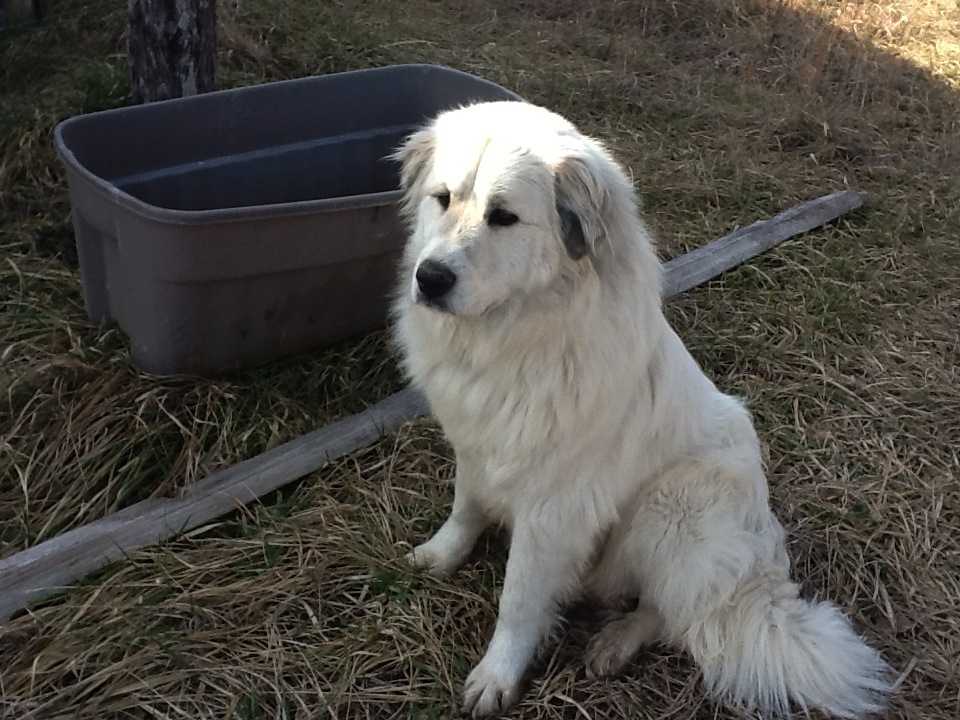
We got Maxie at about 2 months old. We started her off in the chicken’s yard, but blocked off the access to the coop. This gave her a chance to be around the girls, but not so close that she could “play” with them. During the day, Maxie would stay with us around the farm and around the chickens supervised.  Her first encounter with the chicks in the tractor was being pecked on the nose when she got too close.  After that, she would still get close, but not that close.  Once the chicks were in the electric netting, Maxie would stay the night in there with them.

The thing with Pyrs is they are not normal dogs. Fetch, come, roll over…that’s not their thing. I read a lot about training them and how they operate. Natural guard dogs, instinct rules their behavior. They keep their puppiness for almost 2 years, so training is long term. While they’re guard dogs, they’re submissive to whatever they protect. They were originally used for sheep, goats, and cattle, but have been used more for poultry recently. It’s harder to train them for poultry since the birds don’t have the same stature and power as goats or sheep. When a Buck or Doe puts a dog in place, it’s very clear and respected. When a chicken doesn’t like what a dog does, it runs, which entices a chase.

With Maxie, I put her on a schedule and routine right away. At 2 months, that may seem a bit strict, but I believe that it’s easier to train a dog in what’s expected to start than to try to do it later or correct bad behavior. Maxie learned quickly that if she wanted to eat, it was on my terms. I would set her bowl down and if she did not eat right away, I took it away and tried again later. Once she started eating on schedule, I started to make her sit and wait to eat with “stay”and slowly walking away from her. Once she got that, I added “kiss” to it. I know, not really a useful command, but she is so sweet when she does it. “Kiss” is me getting about 6 inches from her face, saying the command, and her lifting her nose to touch mine. Feeding time goes like this: bowl on the ground, sit, kiss, stay, I walk away, sometimes to the other side of the chicken coop, and eat. Everything is accompanied by a hand signal (except kiss) and sometimes, it’s all done with signals.Monitoring the tree line.

Pyrs do not like to come when called. I work with her on this, but even now, she struggles with coming. I would take her on walks around where I wanted her to protect before her feedings.  That was her work before she ate. Some days she loved it, others, it was like pulling teeth. That led to leash training. She did NOT like the leash. I would put it on her and she would THROW herself on the ground and holler and wail like I was strangling her. After a while, she learned that it was better to get it over with than fight it. Then her wandering instinct kicked in. She would bolt down the driveway and head to see the neighbors dogs. I would go and get her, scolding her. I didn’t want her going there because it was on the main road and I didn’t want her to start hanging out there instead of where she was supposed to be protecting. We thought about putting down an electric drive over fence on the drive, but eventually, she stopped going down there. She even started to be able to come to the front barn and do chores with us without straying too far.

I adhere to a very strict I am the alpha dog policy with Maxie.  I take her food from her whenever I wish.  If she finds some nice bone or carcass out in the pasture, I make her drop it, take it from her, and give it back after I pretend to eat some of it.  When she would start to get crazy with the chickens, I would tell her no, pin her down, and growl in her face until she stopped struggling to get away. Even now, a growl will get her attention.  She’s also on a species-specific diet with no treats.  No, not even as a reward.  She eats raw chicken, pork, beef, eggs, salmon, and sardines. We used to give her some kibble because sometimes I forget to defrost the meat, or I just need a quick meal for her. Now that our production is up, we have enough raw food for her and the other dogs. No treats mainly because I want her to do what she does for my approval, not food.  Also, I don’t like dogs that beg for food.  I can sit next to her, eat a sandwich, and she pays no mind.

She had her first protecting incident when 2 dogs came on the farm. Some of the girls were foraging in a pasture a bit farther from the barn than I like, when the dogs were spotted. I went running to them and so did she with a bark and growl I hadn’t heard before. She chased them off and the girls were ok.  Since then, she’s been chasing off deer, rabbits, and even hawks. She keeps the neighbor’s dogs on their property, too.

Maxie is the first dog I’ve had since my Akitas when I was in my early 20s. After losing my male, Kuma, I didn’t think I would ever bond with another dog.  He was such a great dog, I always thought no other would compare.  But Maxie won my heart.  I wanted a work dog, not a companion, but Maxie had other plans.  She can go from being a love hog to running across the pasture in full protection mode in nothing flat.  Some days she has tried my patience to no end. Others she has been the perfect dog. Either way, I am so happy we have her, and wouldn’t trade her for anything.

UPDATE: Since getting Maxie, we’ve added a Gret Pyr x Komondor, Zeke to our protection staff. Maxie was a great teacher and helped Zeke get up to speed with the chickens much faster.  Since Maxie is getting up in age, she has the easy job of tending to the layers while Zeke works the broilers.

Maxie, 1 yr old.


Filed Under: Our Animals Tagged With: Pyrs

Real Pecan Pie

Posted on March 31, 2013 Written by Serena 1 Comment

I have never been a huge fan of pecan pies. Always too sweet for me. And even before I became more concerned with my health, something about basically eating straight corn syrup just seemed wrong. So when everyone else called dibs on all the standard pies for Christmas one year, I decided to try this one. Now, I am a pecan pie addict!

I used the maple syrup we made and substituted sorghum we bought locally for the molasses. And you MUST toast the pecans. It brings out the flavor so much more than just plain. Just be carefully and watch them. I set a timer for 5 minutes and keep resetting until they are done. It is VERY easy to go from toasted to burned. I speak from experience.

Cook’s Illustrated has a great pie crust recipe I have in another post. However, if you don’t want to make your own, they recommend the Pillsbury refrigerated crust over the frozen.

Old-Fashioned Pecan Pie
Recipe from Cook’s Country
(Serves 8-10)

1 Cup Maple Syrup
1 Cup packed light brown sugar
½ Cup heavy cream
1 Tablespoon Molasses (or sorghum)

4 Tablespoons unsalted butter (cut into ½ in. pieces) (I use salted and reduce the salt to 1/4 tsp)
½ teaspoon salt

6 large egg yolks, lightly beaten

1 ½ Cups pecans, toasted and chopped
1 – 9-inch unbaked pie shell,
chilled in pie plate for 30 minutes

Adjust oven rack to lowest position and heat oven to 450 degrees.

Heat syrup, sugar, cream and molasses in saucepan over medium heat, stirring occasionally, until sugar dissolves, about three minutes.

Remove from heat and let cool 5 minutes.

Whisk butter and salt into syrup mixture until combined.

Whisk in egg yolks until incorporated.

Scatter pecans in pie shell. Carefully pour filling over.

Place pie in hot oven and immediately reduce oven temperature to 325 degrees.

Bake until filling is set and center jiggles slightly when pie is gently shaken, 45 to 60 minutes. Cool pie on rack for 1 hour, then refrigerate until set, about three hours and up to one day. Bring to room temperature before serving.

Filed Under: Recipes Tagged With: recipes sweets

  • « Previous Page
  • 1
  • …
  • 15
  • 16
  • 17
  • 18
  • 19
  • Next Page »

Welcome to Stuart Farm!

We’re Serena and Fred Stuart. While raising healthy and happy animals is our #1 goal, we’re also here to serve you! If you’re looking for help in navigating healthy eating and living, you are in the right place! We’re here to answer your questions and help you feed your family meat and eggs you can feel good about. We share farm stories that gives you a peek into our life, recipes to try, health tips, and more. We hope you enjoy coming along on our farm adventures.

Connect with us

  • View StuartFarmLLC’s profile on Facebook
  • View stuart_farm’s profile on Instagram

Contact Us

573-764-2324 please leave a message .
Farm hours are by appointment only.

Tags

Beef recipes broth chickens delivery Devons Dorkings Eggs Farm Life Freedom Rangers garden lard pigs Pyrs raw diet recipes recipes sweets Silver Fox Rabbits Sugaring

Categories

  • Blog Posts (73)
    • Farm Life (39)
    • Mother Nature (1)
    • Our Animals (24)
    • Our Garden (2)
    • Pigs (5)
    • Projects (1)
    • Recipes (16)

Recent

  • 2025-2026 Our Years of Transition
  • Our Farmstay Is Now Open!
  • The Best Way to Take Charge of Your Health
  • Love is…
  • My Summer Reading List

Archives

Copyright © 2026 · Focus Pro Theme on Genesis Framework · WordPress · Log in

Loading Comments...