Stuart Farm

  • Our Story
  • Shop
    • Our Store
    • Where to Buy
  • Come Enjoy a Farm Stay!
  • Our Classes
  • Fertrell Products
  • Contact Us
  • Blog Posts
    • Our Animals
    • Mother Nature
    • Our Garden
    • Recipes
    • Farm Life
    • Projects
  • Consultation Services
  • 0 items

How to make THE best bone broth!

Posted on October 25, 2020 Written by Serena 1 Comment

The first time I made bone broth, I ended up throwing it out. After it cooled, it was like gelatin and I thought I ruined it. Oops! Little did I know, the best broth has a solid gel.

Since then, I’ve had different levels of gel in my broth and I’ve finally figured out how to always get the perfect gel.

I’ve helped a few people perfect their broth, so I wanted to share some tips and the one ingredient that will boost the gel factor.

I’m sure you’ve heard that bone broth is a superfood, right?   Pound for pound, or cup for cup as it were, bone broth is a nutritious and versatile food you want to keep on hand.

Bone broth is a great source of gelatin protein aka broken down collagen (about 10 grams per 8 oz cup), glucosamine and chondroitin (joint health support), niacin, riboflavin, glycine, and proline. Despite popular belief, you don’t get a lot of minerals from bone broth, but that’s ok. It’s a super nutritious food that can help with gut health, healthy skin, and joint health to name a few.

Plus you can use it for more than just soup.  It’s a great sauce base or try cooking rice or quinoa in it.

While you’re sipping on your broth, don’t forget your pets! Bone broth can help them in the same ways it helps you. Since our dogs are large breeds and prone to hip issues, they get bone broth regularly. I feed it cold so it’s gelled and less messy. I have another pet treat tip at the end.

“Regular” Bone Broth

When I cook any bone-in cut, I almost always save the bone (either raw or cooked) in a Ziploc bag in the freezer.  Chicken, pork, beef, shrimp shells, doesn’t matter, it all goes in the bag. Once I have a full bag, I make a pot of broth.

BUT, when I want THE best broth, I use–feet!

Why feet? Because all the collagen containing connective tissue breaks down to create a super gel that bones alone don’t quite have. And that’s what you want–a good strong gel.
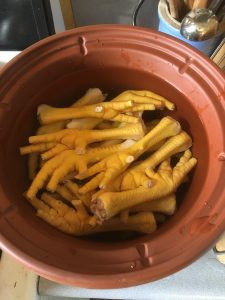
24 feet in my new VitaClay crockpot.

Chicken Feet

I just made a pot of all chicken feet broth and oh man, was that some serious gel!  Even adding 4-6 feet to your regular broth will help increase the gel. I was reading up on it and one source said using all feet has more body than regular chicken broth. I wasn’t really sure what that meant until I tasted it. It was thicker than regular broth, more like a sauce.

For an all feet broth, you can either just put them as is in the pot and cover with water, or you can blanch them and remove the skin. The packs of feet we sell already have the nails removed, so no worry there.

To peel the skin: scald the feet in boiling water for 20-30 seconds. Don’t boil too long or the skin will stick to the muscle. Dump them in a pan of ice-cold water. Peel. They peel best when still warm, so only do as many as you can keep warm while peeling; ~ 4-5 at a time.

Pig Feet

The first time I made pig feet broth I was amazed by the gel.  Like chicken feet broth, it’s solid after cooled. I mean S-O-L-I-D. You can run a knife around the jar and ease it out in one piece like canned cranberry sauce at Thanksgiving. PLOP!

Prep for pig feet broth is a bit different than chicken. Of course, you can just put them in a pot and cover with water, or you can roast them first. Roasting is said to make the flavor deeper. I’ve only ever made it after roasting, so not sure what the other way tastes like.

Pig feet broth is very different from chicken or beef broth in one way–taste.  I don’t drink straight pork broth as I do with chicken or beef.  It just isn’t that tasty to me.  BUT, it’s the absolute best in any sauce or soup! It’s like something magical happens when you put something else in it. I save all my pork broth for sauce or soup bases.
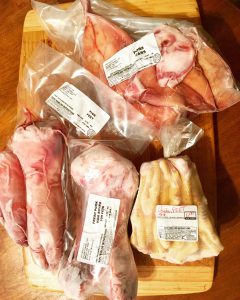
Feet, Bones, Ears

Cooking Bone Broth

Add feet and/or bones to a crockpot with 1 Tablespoon of vinegar and cover with cold water.  TIP: You want the bones just covered. If the bones/feet are a frozen mass, fill with water halfway, heat on high for 1 hour, and wait until you can break them apart to top it off. Cook on low.

There’s no hard and fast rule about cook time, anywhere between 6-18 hours is good.  TIP: try not to cook over 24 hours. If you cook too long, the collagen will break down too much and the broth won’t gel. If any “scum” forms on top, skim it off.

If your crockpot has a warm setting, after 4-6 hours on low, you can switch it to warm overnight.  That should keep it at 160F which is out of the food safety danger zone.  TIP: cooking at too high of heat also breaks down the collagen and ruins the gel. 

Since this is a base broth, I don’t add any veggies or herbs. You can, but I find it easier to strain the broth as is and add in later when I want to use it.

When your broth is ready, strain through a mesh sieve or cheesecloth into jars/containers and set solids aside. Chill in an ice bath until cooled down and place in the fridge for 12 hours.

TIP: leave the fat on top. 1–it’s a healthy fat that’s good for you and 2–it helps seal the broth and keep it fresher in the fridge and safe from freezer burn in the freezer.

It will last a week in the fridge or 6 months in the freezer.
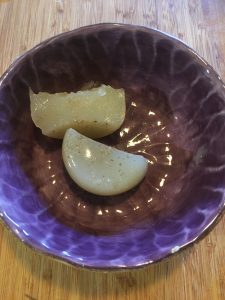
SOLID Gel!

TIP: freeze with at least 2″ headspace for expansion.  If you freeze in glass, put the jar in a bowl and defrost overnight in the fridge. Check for cracks before using.

Now you have a big bowl of bones.  What do you do with that? Depending on what you used, there’s still plenty of meat leftover. Once everything cools enough to handle, pick out the meat.  This is perfect to either add back into the broth or use in tacos.

You can set aside any of the fat, skin, or other “undesirable” soft parts and feed it to your dog or cat as a treat. Just MAKE SURE there are no cook bones in it.  If the ends of the bigger bones disintegrate with mild pressure between your fingers into a meal like feel, you can feed that as well.  This also opens up the shaft of the bone so you can dig out the marrow if you like.

That’s it! Now you have a health boost in a jar. At the first sign of feeling a bit under the weather or stressed more than usual, warm up a cup or two and enjoy.

Ready to start making your own broth?

Click to buy chicken feet, pig feet, or other cuts.

If you need more help or have questions, click here to email me!
 

Filed Under: Farm Life, Recipes Tagged With: broth, recipes

Happy Grandparents Day!

Posted on September 13, 2020 Written by Serena Leave a Comment

What does Grandparents Day have to do with farming?  For me, a lot.

You see, who I am now, has a lot to do with who my grandparents were and how much time I spent with them.

On my Mom’s Side

My mom’s mom, Grams, lived with us for a few years. When she didn’t live with us, we went to visit often.  Grams was a great cook.  Tamales, menudo, tortillas, mexican rice, everything she made was delicious.  And most everything had lard in it.  I remember being in her kitchen. The rickety floor, dimly lit, hot, and kind of scary kitchen.   I would help her make tortillas while I tried to absorb every iota of smell wafting through the air–frying beans, browning rice, a stockpot full of I was never sure what, chili powder, garlic, and cumin.  I loved being in the kitchen with her, but it’s only now I realize the impact it had on me.
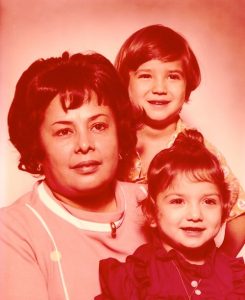
Grams had the softest hands. When I was upset or in trouble, as I often was after my parent’s divorce, I would lay next to her as she’d stroke my face or hold my hand and hum.  Her hum would vibrate through my whole body and calm me. She would take a lock of hair at the root and softly pull to the ends, over and over. To this day, when I am really stressed, I do this.
Grams didn’t spoil us, give us treats, or buy us gifts. I do remember her buying me a small porcelain trinket box at a garage sale for maybe a quarter. It had gold foiled legs and a rose painted on the lid. I still have it. Even as a child, I knew her time and care meant more than anything she could buy.

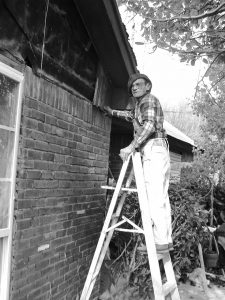
My mom’s dad, Ducky, was another story.  I didn’t spend too much time with him, but the time I did spend was usually intense.  Ducky was a carpenter.  He built the house my mom spent some of her late teens in and lives in now.  He salvaged brick from a housing project that was torn down to build the house.
He was an excellent craftsman and repurposer. After Hurricane Ike, the guys helping gut the kitchen were so excited to smash apart the cabinets Ducky built. I laughed and told them good luck! They tried for about an hour or so, then decided they’d make more progress prying them off the wall.

When I was around Ducky, I would watch with great curiosity. He was a man of few words, and if you only had “a piece of a brain” as he called it, those words could be harsh.

As a child, I was always a bit afraid of him. His gruff voice from smoking since he was 11, his slicked-back jet black hair, and lack of conversation.  But, when I would see him, he’d smile and say, “Oh, Weena, where have you been?”  As I got older, the conversation with him became easier and I learned a lot about him.  During World War 2, he was in the Navy.  On the way home, he and a friend stopped in the South Pacific in hopes of watching nuclear bomb testing.  It was taking too long, so they hopped on the next ship that came through and headed home.
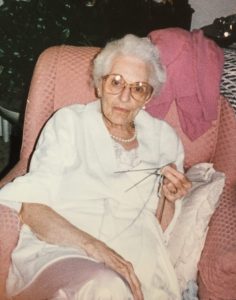
When I was living with my mom, he moved in with us because of his failing health. In his wheelchair, he was still gruff and scary. He’d watch me work around the house and ask me, “oh, Weena, why do you hold the hammer so stupid!?” as he shook his head. I’d give him a hard time about still smoking and he’d proudly say he’d cut back by half–only 2 packs a day now. Can’t argue with that I guess.

On My Dad’s Side

With my dad’s parents, we would see them a few times a month.  Sometimes it was just a quick visit, other times we would stay the night. They always lived in an apartment and I loved staying in the office/art studio/extra bedroom.  And, there was a greenhouse.

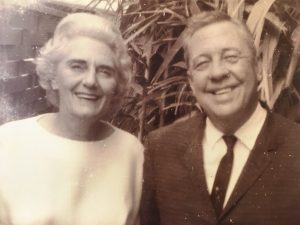
My grandmother, Honey, was an amateur botanist.  She had a beautiful garden in the small backyard and a greenhouse.  I loved sneaking into the greenhouse and examining all the plants she was tending to.  I would carefully examine a new grafting she had done or marveled at an orchid in bloom.  The backyard had banana trees, cucumber vines, and tomato plants covering it. It felt like another world to me.

Honey would tell me stories about sneaking out to go dancing, trips she and her sister took, and when she worked for the Tennessee Valley Authority conducting door-to-door surveys and came across a man with Elephantitis.  Before she died, she told me a story about having the chance to go to the Kentucky Derby and she didn’t go.  She looked at me, shaking her finger like she did when she wanted to make a point, and said, “Don’t ever regret not doing something.”

My grandparents had a bit of an unconventional marriage.  They both worked, and my grandfather, Baboo, did the cooking.  Baboo, like Grams, did not spare the fat in his cooking. While I did have to choke down peas and lamb on occasion, and meals were not by request, he also made special things for me and my brother and sister.
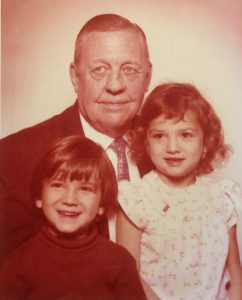
He would make silver dollar pancakes for breakfast and coffee milk–warm milk with a splash of coffee. Like my dad, Baboo loved his Blue Bell ice cream, so having a scoop with some sweet treat he made was common.

We’d play hide-and-seek or CandyLand to pass the time. They would watch golf and we’d all fall asleep. If we were super lucky, Baboo would take us to the post office in his Mach 1 Ford Mustang. I can still smell and feel the red seats as I’d climb in the back.  We’d quietly laugh as he yelled at other drivers.  There was a rocking chair my brother and I would rock in trying to see who could go the farthest back and forth without tipping over.

We’d sleep in a pull out bed in the office/art studio. Honey was a painter and I loved looking at her art supplies and the pictures and books on Baboo’s desk.  My brother and I would play with the old typewriter and silently open the desk drawers to look at Baboo’s wax seal tools.

Unlike my other grandparents, small gifts were given for birthdays and Christmas, usually a book or game, and cards with a few dollars for Easter or Valentine’s day. We never got a gift just because we showed up. The only gift I remember from them is a pack of Strawberry Shortcake underwear I opened at my only non-family birthday party. The only reason I remember is that I was so embarrassed in front of my friends.

Maybe my parents would disagree and say we were spoiled and showered with gifts at every turn. If that’s so, what they bought made no difference in my life at all. What they have shown and shared with me has.

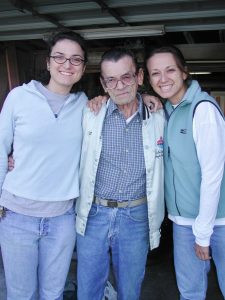
When Baboo’s health began to fail, I would take him to doctor appointments, to the grocery store, and spent as much time helping them as I could. When he was in the hospital, where thankfully I worked, I would take my breaks and go check in on him. The nurses would call when he was being a problem and I would go calm him. I now know he was suffering from delirium on top of the first signs of dementia.

Baboo never got mad at me, except one time in hospital. He asked me to break him out, the camp was surrounded, and we needed to escape. To him, we were back in the Philippines during the war. I told him I would make sure the coast was clear and I stepped out and waited. A nurse asked me if everything was ok and I politely said yes. I went back in and told him there were too many guards, we’d have to wait until tomorrow.

With that, his already pale blue eyes went even lighter and his face hardened as he told me it had to be NOW DAMNIT! He had never spoken to me this way before and it took a bit to calm him down. Later when I mentioned the eye color change to my dad, he snickered saying, that’s how you know when he’s really mad.

At the time, I didn’t want to believe I was losing Baboo to dementia. I didn’t think it was a real thing that could make him forget everything, especially me. But when a nurse asked him who I was and I saw the look on his face as he struggled, searching for me, my heart began to break. Then he smiled and said, “that’s my sweetie pie”.

I was so fortunate to have my grandparents as long as I did. I cherish the time I was able to be there for Baboo, Honey, and Ducky in their final years. Grams was lucky to have my mom, aunts, and uncles to rally around her. I was in Missouri when Grams died. My mom called from the ER and put the phone to her ear so I could say goodbye and thank her for always being there for me.

It’s not just on Grandparents Day I think of them. I think of at least one of them a day. When I drop a big glob of lard in the pan. When I’m building or repair something. When I tend to my plants and pastures. When I put Baboo’s apron on or look up at one of Honey’s paintings.  When I break out Grams’ cast-iron skillet or when I cross my legs and sit just so, just like Ducky.

Who they were lingers in me because of the time and care they gave.

I’ve never been a fan of the “spoil the grandkid” mentality some grandparents have. But looking back on these relationships, I guess I was a bit spoiled. Spoiled with their time. Spoiled with their pride in my accomplishments. Spoiled by their understanding in my screw-ups. Spoiled with unending encouragement. Spoiled with their knowledge.  Spoiled with traditions. Spoiled with learning skills. Spoiled with their care. Spoiled with their love.

There is no greater gift you can give your grandchild than sharing your time and who you are with them and allowing them to do the same for you.

What are your favorite memories of your grandparents or of being a grandparent? Share in the comments.

Filed Under: Farm Life

Get Ready to Start Loving Lard!

Posted on August 19, 2020 Written by Serena 1 Comment

When we started with hogs, besides having super yummy pork, we were really excited about having lard.  We LOVE cooking with lard.
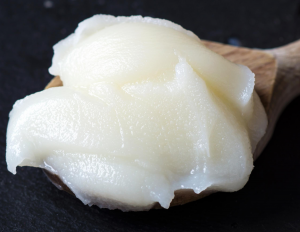
I know what you’re thinking, lard is BAD for you…isn’t it? Boy, do I have some good news for you!

 How can lard be good for you?

When you get lard from hogs raised on pasture with lots of room to roam, soaking in the sunshine, and fed at the very least a non-GMO feed, you’re on the right track to some health benefits.  Yes, I said it–HEALTH BENEFITS FROM LARD!

Lard is 48% monounsaturated fat which may help lower LDL (bad) cholesterol.  Lard from pasture-raised hogs is the second highest food source in vitamin D, after cod liver oil. How does lard have so much vitamin D? Hogs absorb it from the sun and store it in their fat, which is why you want lard from hogs that live outside. There’s a lot to sort out when it comes to fats and Sally Fallon and Mary Enig do a great job explaining it in “The Skinny on Fats”.

When is lard bad for you?

Pretty much anything you buy in the store is NOT what you want.  It’s hydrogenated–processed and mixed with lots of junk to make it whiter and more shelf-stable.  If the label says more than hog fat, don’t buy it.  And just because it’s local doesn’t mean the hogs haven’t been in confinement which will affect the quality and benefits of lard (and pork for that matter).

What about cholesterol?

Cholesterol is good for you. Very, VERY good for you. It aids in cell regeneration, proper synthesis and production of some hormones, especially sex hormones, and absorption of fat-soluble vitamins, to name a few. Those are all really important functions!

The body produces 80% of our cholesterol for a good reason and inherited genetic high cholesterol occurs in only .5% of the population.  So “genetic high cholesterol” is more a combination of learned eating habits and excellent marketing of not-so-good-for-you foodstuff.

So, if our bodies make most of our cholesterol and it performs major bodily functions, why do we keep hearing cholesterol is bad and will clog our arteries and kill us?

Where we get mixed up about cholesterol is WHY our arteries clog.  Hint–it’s not because we eat too much cholesterol.

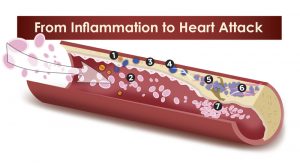
When there’s chronic inflammation in our body, our liver is signaled to produce cholesterol and sends it out to ease the inflammation.  This is different from acute inflammation from an injury like a sprained ankle or cut where white blood cells are rallied to help.

You see, cholesterol has healing properties in normal amounts.  BUT, when your system is chronically inflamed, the amount of cholesterol in your system goes bonkers and starts to build up, walling off the inflamed site, clogging arteries.  Your body is trying to heal itself, but can’t because the inflammation is too great. It just sends out more and more cholesterol to fight and it can build up.

So the question comes down to who’s to blame–the cholesterol that’s trying to heal your body or the inflammation calling on the liver to produce more and more cholesterol?  To have a normal healing amount of cholesterol in your system, you have to eliminate what’s causing the inflammation.

Chronic inflammation can be caused by toxins we breathe in, like form smoking, and what we eat. Inflammatory foods are sugars, refined carbs (breads, crackers, cereals-even healthy organic ones), aspartame, gluten, oils (corn, safflower, sunflower, grapeseed, soy, peanut, and vegetable), and alcohol. 

Low inflammation = low cholesterol.  If you stop eating foods that cause inflammation, your LDL cholesterol can lower and change in type (more on types later) and HDL (the good stuff) increases on its own. No meds needed.

There have been several studies that show eating saturated fats do not increase your risk for heart disease, but eating sugary and starchy food can double your risk (Source). Cholesterol also has a crucial role in synthesizing Vitamin D.  This article has great information about Vitamin D and cholesterol.

There’s still a lot of out of date info about cholesterol circulating and it’s hard to move past the idea of a low-fat diet being good for you.  You can read this,  this, and this article for more great information about why you should rethink the cholesterol myths. And this article is the latest on the myth of saturated fats and heart disease you really need to read.

And remember the fat-soluble vitamins I mentioned earlier? What that means is if you don’t have enough fat in your diet, you won’t be able to absorb those vitamins as easily. That means they won’t get stored in your fat and liver for later use. That expensive supplement pill or powder you take daily for your vitamin A, K, E, and D? If you don’t take them with a balanced meal including fats, you may not be getting your money’s worth.

My Story

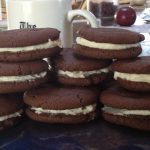
Homemade Oreos!

When my cholesterol was at 200, my doctor at the time was hinting at meds. I had other plans. After some research, I decided we would eliminate all processed sugary treats, decrease our bread and boxed processed foods intake. If we wanted a sweet treat, we would have to make it and I’d usually cut the sugar amount in half.

At first, we went crazy making sweets and bread. Then it became quite a bit of work, so we slowed down and more often than not, just went without.

Some of the changes: Fred was eating 2 sandwiches a day for lunch and that dropped to one–taking out about 15 loaves of bread a year from his diet. We replaced store-bought bread with sourdough bread Fred made because it’s easier on your digestion and blood sugar (now I will buy store-bought sprouted bread). I slowly weaned us off chocolate chips-our throwdown sweet-from 52 bags to 26 to less than 12 a year.  Switched from flour to corn tortillas and dropped the amount of sugar Fred put in his tea.

Within a year, both of our total cholesterol dropped 20 points and our HDL increased.  Now, this whole time we ate a minimum of 3 eggs a day each and LOTS of meat.  Most doctors would say to cut those things out because of the cholesterol.  But since we cut down on sugar and flour, our liver was not sending out the signal to produce excess cholesterol and our bodies were able to utilize fat-soluble vitamins better. And remember, we only get 20% of our cholesterol from food.

What we were doing was eating healthy pasture-raised animal fats that were actually nourishing our bodies while removing/reducing sugar, grains, and chemicals that cause inflammation.

To be clear, we don’t always eat the best. If we are out and about, Fred may get a soda. We’ll have a slice of cake or pie at a family gathering. I’ll beg Fred to make kettle corn for movie night. Eating better is not an all or nothing thing.  It’s just that, eating BETTER. I don’t beat myself up when I eat less than great, I just do better.

What do the numbers mean?

More important than total cholesterol is your cholesterol ratio and if you have a high LDL, what type of LDL.

Your ratio is your total cholesterol divided by your HDL level.  The optimal ratio is between 1:1 and 3.5:1. A higher ratio increases the risk of heart disease.

Not all LDL is created equal and your run of the mill lipid test doesn’t give you the big picture. LDL can be tested to tell you if your LDL is large, medium, small, or very small.  Large decreases your chance of heart disease and very small increases it.

Let’s look at my last Lipid panel with the normal range in ( ).

Total: 217  (<200)
Triglycerides: 51  (<150)
HDL: 86  (40-59)
LDL calculated: 121 (<100)
Non-HDL cholesterol: 131  (<130)

Ratio: 2.5:1  (217/86 = 2.52)

At first glance, you are probably freaking out, right?  What’s low seems so low, and what’s high seems so high. My doctor was so happy with these results. Here’s why (and why I LOVE my Dr.).

While I didn’t have my LDL broken down to the type, which I will next time, my doctor knows my diet and exercise level and takes everything into account. Super low Triglycerides but high LDL, a diet full of good fat, and an active lifestyle means more than likely, my LDL is the large type and not the small stick to my artery wall type.

What about that low Triglyceride number? Very-low-density-lipoprotein, VLDL, the small LDL, is made up of triglycerides, cholesterol, and apolipoproteins. Not a lot of triglycerides, not a lot of VLDL.

See that HDL off the charts? That means I have a lot of “good” fluffy cholesterol keeping any “bad” small LDL cholesterol in check.

When you remove my good HDL from the equation, my Non-HDL cholesterol could still be seen as borderline. But again, looking at the big picture, my doctor sees an overall low risk of heart disease.

Are you thinking, “you didn’t mention your TOTAL cholesterol!” There’s a good reason for that.  As my doctor says, it doesn’t really matter. It’s what the other numbers tell TOGETHER that gives you a more accurate picture of your health and heart disease risk. This is the thinking among doctors as they open up to the new research on cholesterol and heart health.

Want to learn more about cholesterol? Read The Great Cholesterol Myth by Jonny Bowden, Ph.D., C.N.S., and Stephen T. Sinatra, M.D.  You can listen to it for free on the Hoopla app.

What do I do with my lard?

Oh, good lard, I am so glad you asked! Yes, there has to be at least one lard joke.

My Mexican grandmother used lard generously.  I have her HUGE cast iron pan she used to make fried rice and beans in.  I can still smell the chili soaking into the hot lard and the amazing glistening that coated everything she cooked.  You really can use lard for all your cooking needs.

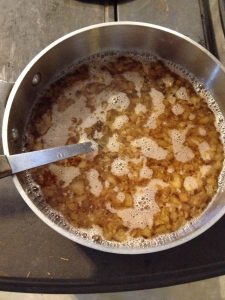
Heating the fat.
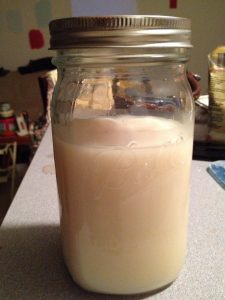
Cooling down.
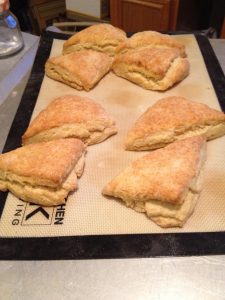
Biscuits!

Lard makes THE BEST biscuits and pie crusts.  Lard gives baked goods light flakiness you just can’t get from other fats.

Now that we have lard, I use it for sauteing and roasting veggies or browning meats.  You can use less lard and get better flavor and less oiliness.  It also makes the best fried eggs.

Lard had a higher smoke point, so frying in lard makes the best fried chicken or fish.  Did you know when you heat vegetable oils too high or reuse it, it oxidizes and releases free radicals that can cause inflammation? No thanks!

Lard is a great butter replacement on pasta and bread.  Mix in some herbs and spices, let it set in the fridge overnight, and use it as you would butter.

Real pure lard is fine at room temperature and won’t go bad for months, but we store what we are using in the fridge and extra in the freezer.

If you are interested in how and why we stopped using lard and started eating things like margarine and Crisco, click here.

Ready to try some lard? Click here to order!

Want to make your own? Click here for leaf fat.

>>> I am Not A Physician <<<

**Disclaimer:  I am not a physician and this is not medical advice. If you have concerns about your cholesterol level and health, please contact a physician you trust and is informed of the latest research. If you are currently taking a cholesterol-lowering medication, please contact your physician before decreasing or stopping any medication.**

This article is about my research and my health changes and is only serving as encouragement for you to continue researching your health and medical options. A physician who listens to your concerns and values your input is the best place to start taking control of your health.

Filed Under: Blog Posts, Farm Life, Recipes Tagged With: lard

Zeke, Our Goofball Guardian

Posted on August 16, 2020 Written by Serena 2 Comments

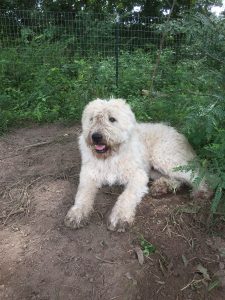
Today is Zeke’s 4th birthday and since his sister Maxie has her own post, I thought it was about time to tell his story.
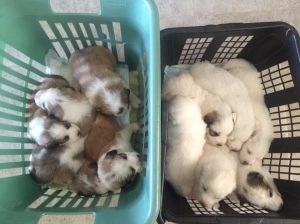
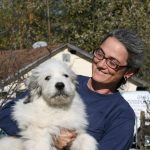
When our friend Kim adopted Lucy who was pregnant, I happily watched on Facebook, thankful I was not dealing with puppies anymore.  Lucy had 11 puppies. 11 adorable puppies.

I would see the pups and go out to Maxie, thinking I was so happy she was finally out of her puppy stage at a little over 3 years old and could be left alone with the chickens. But then I notice her getting up a bit slower. Not being quite as eager as she once was to run the length of the field.  And it hit me–in a few more years, she’ll be on her way to retirement. Who will replace her?

A puppy.

I went back and forth with Kim about which one was available, who did she think had more Komondor than Shepard in them, what about this, and what about that, until I’m sure she thought I was nuts.

I wanted a boy, and since most were already spoken for, we got Zeke. Looking back, it was like no one else chose him because he was meant for us.

I spent the next couple of months watching him grow on Facebook and waiting for him to get big enough (and neutered) to come home.

When the time came, I drove up solo with the backseats down so he could either hang back or come close to me.  We had a little playtime together while I visited with Kim and her mom. I filled out all the paperwork, got his records, his blanket someone had gifted all the puppies with, scooped him up for a quick photo, and away we went.

He stayed in the back with his head on his blanket most of the ride home. After a little puke, he came up front and curled up in the passenger floorboard. We had a nice chat about his new home, his new big sister, and what was expected of him.

At home, we let him and Maxie sniff a bit across the fence and then I went in with him to make sure all was good with them. Maxie was, well, not impressed. Zeke would try to get close to her and she would look at him and walk away. But, slowly, day by day, she let him stay a bit closer.

Part of the reason we got her replacement while she was still working was so she could help teach him what he needed to do, and more importantly not do, with the chickens. That didn’t quite go as planned. While we lost probably 8-10 chickens to Maxie during training, Zeke topped out at 3-4. I’d love to say that was because of Maxie showing him the ropes, but that was not the case.

Once when he had a chicken, Maxie just watched him until she saw that I was watching. Then she took off after him, pinned him, then looked up at me. Needless to say, I was not impressed with her delayed response.

At Kim’s, Zeke was around a lot of birds. While that in and of itself doesn’t train them with poultry, it does help. So I went back to what I did with Maxie: supervised time with the chickens.  Within a few months, I felt really confident in his ability and he has been great with all the chickens ever since (knock on wood).

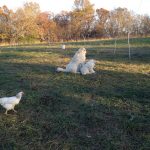
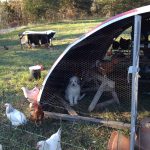
After he was here for a month, he followed Maxie’s lead and when some bald eagles were circling the pasture, he went straight into protection mode.  Barking like crazy and sounding pretty fierce for a big fluff ball.  It’s taken him a while to find his own groove and not rely on Maxie all the time, but he definitely has and he takes his job very seriously.

When we have layers and broilers both running, Maxie gets the cush job of the layers and Zeke stays with the broilers.  They spend about 6 months together and 6 months apart. When we put them back together, it’s like they saw each other the day before–no problem except Zeke annoying Maxie to play.

One day collecting eggs, a new hen was pecking me and I was yelling, “ouch, ouch, ouch!” Zeke came barreling down from the other side of the field in a full vicious bark and stopped right in front of me scanning for the danger.  Oh, my heart! Even after watching him with the chickens, it never occurred to me that he would be protective of me.

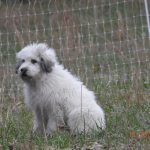
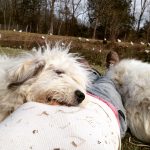
He’s grown into a big beautiful dog but still has the biggest goofball ways. He loves rolling around and if you are even somewhat close to the ground, he’s in your lap laid out into a full stretch. He loves nosing around to see what we’re doing and laying down right where we need to be offering up his belly for a scratch.

Just like Maxie, I don’t know what we’d do without him.

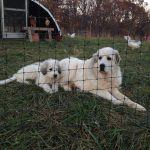
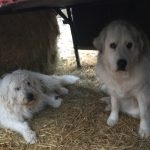
Maxie finally warmed up to him…
and he never left her side…
ever.
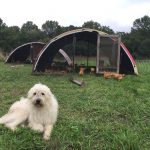
On watch.
Nap Time.
Taking a break.
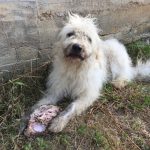
Raw food diet.
At work.
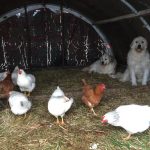
Working together.
Are you comfortable?
Brushing takes forever.
Bit by bit the winter coat comes out.
Hanging out in the snow.
He loves Fred!

Filed Under: Farm Life, Our Animals

  • « Previous Page
  • 1
  • 2
  • 3
  • 4
  • 5
  • 6
  • …
  • 19
  • Next Page »

Welcome to Stuart Farm!

We’re Serena and Fred Stuart. While raising healthy and happy animals is our #1 goal, we’re also here to serve you! If you’re looking for help in navigating healthy eating and living, you are in the right place! We’re here to answer your questions and help you feed your family meat and eggs you can feel good about. We share farm stories that gives you a peek into our life, recipes to try, health tips, and more. We hope you enjoy coming along on our farm adventures.

Connect with us

  • View StuartFarmLLC’s profile on Facebook
  • View stuart_farm’s profile on Instagram

Contact Us

573-764-2324 please leave a message .
Farm hours are by appointment only.

Tags

Beef recipes broth chickens delivery Devons Dorkings Eggs Farm Life Freedom Rangers garden lard pigs Pyrs raw diet recipes recipes sweets Silver Fox Rabbits Sugaring

Categories

  • Blog Posts (73)
    • Farm Life (39)
    • Mother Nature (1)
    • Our Animals (24)
    • Our Garden (2)
    • Pigs (5)
    • Projects (1)
    • Recipes (16)

Recent

  • 2025-2026 Our Years of Transition
  • Our Farmstay Is Now Open!
  • The Best Way to Take Charge of Your Health
  • Love is…
  • My Summer Reading List

Archives

Copyright © 2026 · Focus Pro Theme on Genesis Framework · WordPress · Log in

Loading Comments...