Stuart Farm

  • Our Story
  • Shop
    • Our Store
    • Where to Buy
  • Come Enjoy a Farm Stay!
  • Our Classes
  • Fertrell Products
  • Contact Us
  • Blog Posts
    • Our Animals
    • Mother Nature
    • Our Garden
    • Recipes
    • Farm Life
    • Projects
  • Consultation Services
  • 0 items

Calving in the Snow–Fun, Fun!

Posted on November 27, 2018 Written by Serena 8 Comments

Two weeks ago we had our first real snow. Of course, Queen decided that was the perfect time to have her calf, as well as break into a different pasture.

She was super late calving, so when I found her laying down off by herself with snow on its way, I was not happy. How am I going to manage a downed cow all on my own? When she stood up with blood on her tail, I made her start walking and frantically started searching for a calf. All the while telling myself, “she’s up, that’s the important thing. I can deal with a calf or a miscarriage, not a downed cow”.

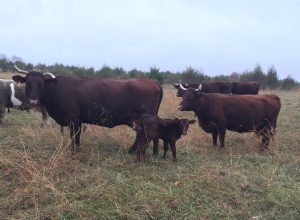
As I walked her into a stand of cedars, it started to flurry. She stood there, back hunched, but nothing coming out as I backed into the branches for extra cover. I turned to see the peanut gallery lined up watching. Every other cow, steer, calf, and bull was in an almost perfect line, peeking out of the trees, watching her. Lilly was in a tizzy, mooing softly, pacing, obviously worried. I trust these guys to know what’s good or bad more than myself, so seeing both of these things did not set my mind at ease.

Queen would look back at me from time to time and I decided to give her some space and let whatever was going to happen, happen. I knew what was going on, I was close, and I had my herd watching and hopefully alerting me to any new developments.  With one ear turned to her, I went to check the broken fence and make repairs.

As I cursed Fred for making a permanent power jump right where I needed to fix, I started the walk all the way back to the barn to cut the power and something in the middle of the next pasture caught my eye.

I turned just in time to see a little calf butt plop down in a tuft of grass. YES! Alive and, once I get it over to Queen, well.  As always, new calves are too tired to run away, so I gave it a quick check and as I grabbed the back leg to reveal the gender, I said a quick, “please be a girl, please be a girl!”  Queen has always given us boys, and having a girl from her and Redd would be a genetic jackpot.

A boy.  Now is the perfect time to do our crimping castration.  He’s easy to handle and still a bit out of it from being born.  But I don’t have the implement, nor the ability to hold him by myself, so that would have to wait.

By now, the snow is coming down pretty hard and this boy isn’t moving.  I am screaming at Queen to call him.  Taunting her that I am touching her baby and what’s she going to do about it. Nothing. I pick him up by the backside so she can see me handling him and still, nothing.  All I want is one good moo calling him to her and my job will be so much easier. But for some reason, she is just fine with me breaking my back to get him to stand, both of us getting covered in snow.

By this time I m screaming “Baby boy, you HAVE to GET UP!!!!  You HAVE to get OUT OF THE SNOW!!!!”  But he won’t listen. I decide dragging him by his back legs is better than leaving him in the snow with zero cover.  He decides otherwise. Ok, the front legs.  That gets me about 2 feet closer to Queen, and still no moo from her.  One more try with the front and he pops up.

I’ve found the only way to get a newborn calf to move is walk directly behind it, gently nudging on each side of the rump and guiding it with my hands.  And we we’re walking!

I get him to duck under the fence as Queen lets out a low moo and he walks around to nurse.  With my smell all over him, Queen starts to methodically lick every place I touched, side eyeing me as she decontaminates him.  Lilly comes over to try to lick him and Queen lets her know she needs no help. I give him a few minutes to eat and then usher them back into the trees so she can find a spot to bed him down.
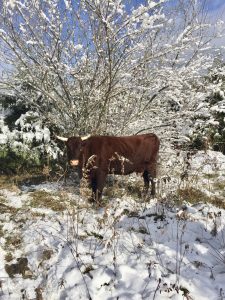
Lilly doesn’t mind the snow.

Three days later, we get about 4-5 inches of snow.  As much as I want to go find that little boy, I know it’s a waste of time.  When a cow beds down her calf, you can’t find it.  Somehow they can hide them in a tuff of grass and you will walk right past them.  It’s some kind of crazy momma cow magic.

Friday, I walk down and see Queen. She is up, bag is full, but not too full, and she looks well.  I don’t see baby boy.  Queen is calm, and so is Lilly, so I am sure where ever the calf is, he’s fine.

A week after his birth is the first time I see him. He’s playing with BJ, nursing, roaming among the herd, bright eyed and active.  Keeping our herd on pasture year round definitely makes for hearty stock!

So what do you name a little boy who survived a snow storm on his birthday and an even worse one a few days later?  You name him after the god of snow, Boreas. Bo for short.  We haven’t decided on castration or not.  And the thought of wrestling him in the cold and mud is not that appealing right now. I’m getting enough of that with the pigs. So if he stays a bull, his official name will be Boreas Rey de la Nieve, Boreas King of the Snow!
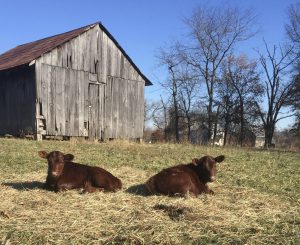
Bo and Millie on a hay bed.
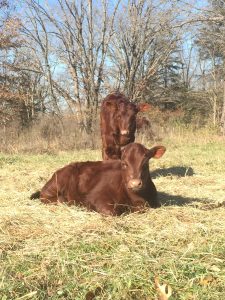
Bo and Dora enjoying the sunshine.

Filed Under: Farm Life, Our Animals Tagged With: Devons

How I listen to the animals

Posted on September 2, 2018 Written by Serena 6 Comments

The other day we brought Momma Pig (MP) up to our place to have babies.  Now, MP is not the friendliest of sows.  Not mean or aggressive, she just doesn’t want you next to her. Or touching her. She’s been like this ever since she came to us in January.  Yet when we brought her up, something changed.  In her new pen, she was oinking, oinking, oinking at me while I filled our feed buckets with water. We wanted to move her when it was cool, so I hadn’t filled up her mud hole yet. Water in the hole and oinking stops.

I wanted to gain her trust, so she got a few big squash and a melon while I finished cleaning out her stall.  She watched me as I shoveled out old bedding and told her about what I was doing and what was to come.  “MP, you need a nice clean stall so you can have nice clean babies next week.  NOT this week, next week, right?  No early babies like last time.  I’m making a nice pasture for you to eat in and you can go swimming in the pond to cool off now, too.”  And on and on I went with MP giving a grunt here and there.

Then she stood next to me.  My heart almost stopped.  MP came next to me. On her own.  Well, that seemed like my cue to give her a bit of a rub down the back.  She shook her booty a little, so I reached down and rubbed the side of her belly.  With that, MP flopped down for a full belly rub. My heart did stop then!

A few days after Trudy, our sow, gave brith we had some rain move in.  She was standing outside the barn stall waiting for dinner and with all the rain, it was quite the muddy mess.  I could hear the babies oinking around inside and one decided to pop his head out the door.  Trudy did not like that! She turned and gave him a stern oink that set him shooting back into the stall.  I don’t need to speak pig to know she told him outside was no place for him and to GET BACK IN THERE! 

Watching and listening to the pigs is by far my favorite thing.  The sow will go lay down away from the piglets and let out an oink that’s the dinner bell and all come running.  When they get too bitey, she lets them know.  When one isn’t latching on as he should, she directs him until he gets it right and then all oinking stops.

I can tell when the dogs are warning a predator to stay away versus warning us that a cow has gotten out.  The rooster’s crow can either be calling the girls for a treat or warning of a hawk.  I can tell when the cow’s moo is just calling baby to come or letting us know something is not right.

Our job as their caretakers is to watch them and listen to what they are saying and make sure we do what is needed.  I’ve lost track of how many times I’ve run out to the pasture because of an odd crow or moo.  I feel like I know most of the sounds they make and when a new one happens, I need to go check things out.

We’re a small farm.  Part of the reason we stay small is so we CAN listen.  If we had 50 sows or brood cows it would be harder to listen.  I couldn’t spend the time I do watching, listening, and yes, just plain babying them the way I want to.  The way we feel they deserve to be treated.

Our days are filled with chores and projects. Some days are busier than others, but every day we take time to watch our animals to assess their health and wellbeing.  And I always have one ear turned to them, listening, assessing, and waiting to hear what they have to tell me.

Filed Under: Our Animals

The Story of Sasha, the Bottle Calf

Posted on July 29, 2018 Written by Serena 4 Comments

After a full day of chores and butchering our last 27 (of 400) meat chickens, I was daydreaming about what I would do with my new found 2 free hours a day. Then there was a familiar knock at the door.
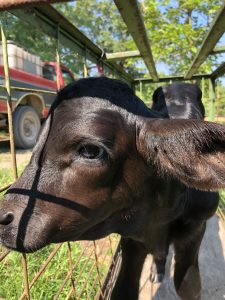
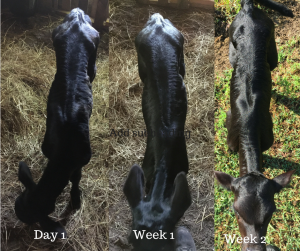
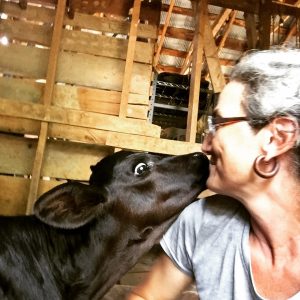
What was my Old Timer doing here so late?

He told us about a cow he was tending to with a week old calf that was not doing well.  She was his partners, but he tends to the day-to-day management of the cattle.  The cow had 2 previous calves that did not survive, and if this one didn’t get on the bottle, that would be her fate as well.

He explained that she had a full bag and would allow the calf to nurse, but the milk was bad.  The calf wasn’t getting any nutrients.  He didn’t have time to bottle feed right now, and if he couldn’t find anyone to take her…

Well, there went my new found 2 hours of free time.

The next morning, we loaded up a crate and went to get the calf.

We headed out to the pasture and found the pair.  The calf was skinny but bright eyed.  We cut in between the two and Fred scooped up the calf, jumped in the back of the gator, and we took off.  The cow followed us a bit and I jumped out to close the fence just in time.

We got her in the crate and looked her over.  She was skinny, showing her spine and ribs, but not dehydrated.  Her ears hung a bit, but her eyes were clear.  Then we found maggots on her anus.  Old Timer sprayed it with some worm spray to kill them until we could get her washed off.

Old Timer tells me not to name her until we’ve had her a week.  My reply? “Well Sasha, isn’t that the silliest thing you’ve ever heard?! ”  He and Fred groaned.

At home, I washed her backside and thankfully that took care of that.  The maggots were less than 12 hours old, so we got her just in time.  I mixed up a cup of formula for her and got ready for a fight.  The last time we had a bottle calf, he didn’t want anything to do with the bottle–he wanted his momma!  Sasha was hungry and took to the bottle instantly.  Whew!

We moved her into a barn stall next to Trudy and the piglets.  Until she was eating well and having normal poops, it was better to have her on her own.

She hadn’t had any nutrients in her system, so we started her slowly on feed.  Usually, bottle calves start with 1 quart of milk two times a day.  Sasha started out with 1 cup four times a day.  She wasn’t too happy about it–she wanted to eat!  The next day another cup was added, and another the next day, until she was up to 2 quarts split into four feedings a day.  Starting her too fast could have lead to diarrhea, which is another whole issue to deal with.

When you read up on bottle feeding, they talk about proper positioning of the bottle, amounts to feed, weaning, and such.  They sometimes talk about leaving right after feeding because the calf will want to eat and chase you around, sometimes head butting you.  Yes, Sasha did this.  She sucked on my arm, pant leg, boot, whatever she could get a hold of.  And she would but me with her head, sometimes in my crotch.  It’s not that annoying or painful, so I’d stick around and play momma.

While I can’t, and don’t, lick the calf as her momma would, I do what I can to help groom her.  She gets rubbed down from head to toe–literally.  It’s not as good as a momma licking, but it helps to stimulate circulation and digestion.  The other benefit is getting her used to being handled.  When you have a sick or injured animal, the easier it is to handle them, the easier your life will be.

Being affectionate or trying to suck my face like a bottle?

Her first full week went well.  During feedings, I would wipe down her backside to get any poop off to keep flies to a minimum.  This is something her momma would do as it also stimulates pooping.

After week one, Sasha had normal poops, so I moved her in with the herd.  On a day I was home all day, I did her morning feeding with the herd.  After she ate, all was well as she cautiously inspected everyone.   I watched for half an hour and decided she was ok.  When I checked back in an hour, she was gone.

Being a baby still, I knew she would search out tall grass to hide in.  And since I left the fence up from when the other calves would go in the tall grass, Sasha made her way there.  Once she saw the bottle, it was easy to get her back in and lower the fence.

Slowly but surely, she began to put on weight and gain more strength.  She slowly moved closer to the herd and followed them out to the pasture.  June Bug and George still weren’t too friendly with her, but they tolerated her well.

At week two, she was looking ready to find a new home.  I would’ve loved to keep her, but we are right where we want to be with our herd as far as breeders.  With a face like this…

…it didn’t take long for someone to fall in love with her.

Sasha is off to her new home with a new brother to keep company.  Thanks for coming into my life little girl; you will be missed.  Now to enjoy my new found 2 hours of “free time” a day until the new chicks come in 3 days.

Filed Under: Farm Life, Our Animals

Breeding to Butcher–Part 3 Going to Market

Posted on September 15, 2017 Written by Serena 3 Comments

Our last batch of hogs are back from the processor, so it seems like a good time to talk about the worst part of our job.  One of the most common questions we get is “how do you kill/eat the animals you raise”?  I write about death on the farm here, but the short answer is…it’s hard. Really, really, hard.  Just thinking about it gives me knots in my stomach.
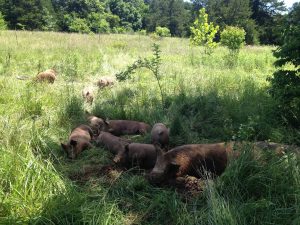
Once the piglets are weaned, they spend their life out on pasture eating grass and rooting up whatever they can find.  When the nuts are falling off the trees, they go into the woods to hunt for acorns, hickory nuts, and walnuts.  They lounge in the sun and make giant wallows to cool down in.

Even though a sow can breed 3 days after weaning, we wait at least 3 months to give her some time to recoup.  We also saved a gilt (female) from Corky’s litter to use as a replacement breeder.

We wait until our pigs are at least 7 months old before they go to the butcher.  Heritage breeds grow slower than commercial breeds and the extra time allows for a better flavor and texture of meat.  We also get our hogs to about 250-300 pounds before butchering.

When we had Shooter butchered, they let me stay through the whole thing, walked me through what and why they were doing what they did, and answered all my questions.  It was hard. REALLY hard.  But if I am going to sell meat, I want to know exactly what is happening to my animals when I take them to the butcher.  If someone has a question about the process, I want to be able to answer from my personal experience, not from what I have read or heard. Having a processing team I trust makes it a bit easier, but my heart still aches as we drive away.  Every time, I hold it together until we go feed the others.  Then the tears start to flow.

It’s something that will never get easy.  Like with the chickens.  Number 650 is just as hard as number 1. I think there’s a difference between getting used to it and coming to terms with it.  Getting used to it means I have been doing it too long and I have lost my compassion for the animal and for the gift they are giving us.  Coming to terms with it is knowing that how we raise our animals and how they are butchered makes a difference.  That’s how I know we are giving our animals a great life.  If we didn’t care, it wouldn’t be this hard.  I never want to be ok after we take an animal in to be butchered.  Even though it would be harder, both physically and emotionally to do it ourselves, I do wish we could.  We are lucky enough to not have to load up our chickens to haul to a processor, and I wish that were the case with our hogs and cattle.

We hope you have enjoyed the journey we take from breeding our sows in Part 1, to having piglets in Part 2, and now understanding why giving our hogs the best life they can have is so important to us.

[et_bloom_inline optin_id=optin_1]

Filed Under: Our Animals, Pigs Tagged With: pigs

  • « Previous Page
  • 1
  • 2
  • 3
  • 4
  • …
  • 6
  • Next Page »

Welcome to Stuart Farm!

We’re Serena and Fred Stuart. While raising healthy and happy animals is our #1 goal, we’re also here to serve you! If you’re looking for help in navigating healthy eating and living, you are in the right place! We’re here to answer your questions and help you feed your family meat and eggs you can feel good about. We share farm stories that gives you a peek into our life, recipes to try, health tips, and more. We hope you enjoy coming along on our farm adventures.

Connect with us

  • View StuartFarmLLC’s profile on Facebook
  • View stuart_farm’s profile on Instagram

Contact Us

573-764-2324 please leave a message .
Farm hours are by appointment only.

Tags

Beef recipes broth chickens delivery Devons Dorkings Eggs Farm Life Freedom Rangers garden lard pigs Pyrs raw diet recipes recipes sweets Silver Fox Rabbits Sugaring

Categories

  • Blog Posts (73)
    • Farm Life (39)
    • Mother Nature (1)
    • Our Animals (24)
    • Our Garden (2)
    • Pigs (5)
    • Projects (1)
    • Recipes (16)

Recent

  • 2025-2026 Our Years of Transition
  • Our Farmstay Is Now Open!
  • The Best Way to Take Charge of Your Health
  • Love is…
  • My Summer Reading List

Archives

Copyright © 2026 · Focus Pro Theme on Genesis Framework · WordPress · Log in

Loading Comments...