Stuart Farm

  • Our Story
  • Shop
    • Our Store
    • Where to Buy
  • Come Enjoy a Farm Stay!
  • Our Classes
  • Fertrell Products
  • Contact Us
  • Blog Posts
    • Our Animals
    • Mother Nature
    • Our Garden
    • Recipes
    • Farm Life
    • Projects
  • Consultation Services
  • 0 items

The Terroir of Meat

Posted on July 23, 2020 Written by Serena 2 Comments

If you know wine, you’ve probably heard the term terroir.

Terroir: /terˈwär/
noun: terroir

  1. the complete natural environment in which a particular wine is produced, including factors such as the soil, topography, and climate.
    • the characteristic taste and flavor imparted to a wine by the environment in which it is produced.

I was recently listening to Bread, Wine, Chocolate: The Slow Loss of Foods We Love by Simran Sethi and she wrote about terroir not just in wine but in chocolate, wheat, coffee, and beer.

So I started thinking about the conversations I’ve had with customers.

One woman said she like our beef better than another farm’s, even though we have the same practices, had cattle from the same herd, and lived only 20 miles apart.

People say our eggs are the best they’ve ever eaten, even though eggs they buy from other farms have the same practices as us.

So I started wondering…could it be terroir?

Yes, it is!

The main reason our meat tastes different from store-bought is that store-bought is all raised the same way. Year after year, raised in the same conditions, fed the exact same thing, butchered at the exact same age. Quality is not left to chance; it’s all about consistency.

On our farm, Mother Nature has a hand in what our meat and eggs taste like.  What grasses, forbs, brush, and “weeds” grow well this year.  Will there be an explosion of crickets or, if we’re really lucky, cicadas this year? Will a momma put on plenty of milk giving the baby a growth advantage? Did the oak, hickory, and walnut trees produce nuts well for the pigs? Did a mild winter mean less weight loss?  Did rains push more earthworms to the surface to feed the chickens and pigs?

It’s not just the environment that factors into our meat quality. When we butcher an animal, their age has a lot to do with the end product.

You’ll hear people say that a younger animal is more tender, not tough like an old breeder cow or sow.  What I talked about in this post, debunks that myth.

If what an animal eats gives its meat flavor, then the older the animal, the longer they eat, and more flavor they can develop.

Often, with customers new to eating heritage breeds, I’ll suggest they buy something from a variety of farmers to find what they like.  I tell them to find out where the farm is, the breed of animal, target age of butchering, feed type, and raising practices.  A Tamworth hog raised on pasture will taste different from one raised in a pen and a beef butchered after eating spring grass for two months will be very different than a beef months into a drought.

I’ve had customers say grass-fed beef is “too strong”.  What they’re tasting is actual beef flavor that store-bought just doesn’t have anymore.  I have a hard time putting anything but salt and pepper on our beef so the flavor isn’t covered up.  People joke that tofu tastes like whatever sauce you put on it. I feel the same way about store-bought meat and eggs.

So the next time you bite into that steak, chop, drumstick, or egg, know that what you are tasting is more than meat. It’s our farm, our practices, our breeds, our love.

It’s terroir.
Filed Under: Farm Life, Recipes Tagged With: recipes

Easy and Delicious Vietnamese Garlic Chicken

Posted on June 6, 2020 Written by Serena 2 Comments

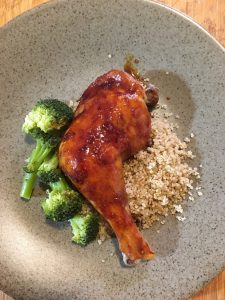
Leg thigh quarters are by far our favorite chicken cut.  On the BBQ, split for fried chicken, roasted with all that crispy skin, always with moist dark meat. What’s not to love!
If you’ve always wondered how to prepare chicken quarters or need a new recipe for them, this post is for you.

This is a mash-up of Wellness Momma’s Honey Garlic Chicken Thighs and Milk Street’s Vietnamese Caramel Chicken. One didn’t seem spicy enough and the other had me standing over the stovetop, neither of which I really like.  Bring on the spice and let me walk away!

Easy and Delicious Vietnamese Garlic Chicken

Preheat oven to 375F.

4 Stuart Farm Leg Thigh Quarters

1/4 c. flour of choice

1/4 c. honey or maple syrup or a combo of the two

2 Tbsp coconut aminos or soy sauce

2 Tbsp water

4-6 cloves of garlic minced or through a garlic press

2 tsp fresh ginger chopped

2 Tbsp fish sauce

1 tsp Gochujang sauce or Schiracha (optional for some heat)

1 Tbsp lime juice

Dredge chicken in flour until coated and shake off excess.

Place in a shallow baking dish.

Whisk remaining ingredients (except lime juice) in a small bowl and pour over chicken.

Cover loosely (cookie sheet on top is fine) and bake 15 minutes.

Remove cover, spoon sauce over chicken. If the sauce is getting too thick add 2 Tbsp water to the pan.

Continue baking uncovered until internal temp reaches 165F.

Drizzle lime juice over chicken and serve with steamed veggies and rice or quinoa.

Filed Under: Blog Posts, Recipes

Get Ready for Fall–Bacon Wrapped Butternut Squash

Posted on September 20, 2019 Written by Serena Leave a Comment

No matter where I’ve lived, Fall was always my favorite season. Maybe it’s because most places had stifling hot summers and the cooler weather (75 is cold, right?) was a welcome break.
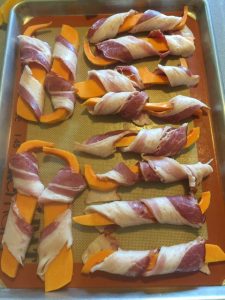
But more than likely it’s because I LOVE comfort food!

Now that I am in Missouri, not only do I get beautiful fall foliage, I have a Fall and Winter that beg for hearty rich comfort foods. And this recipe is the perfect welcome to Fall!

A couple of tips/options for this.

  • You can cut the squash in chunks and wrap smaller slices of bacon around it for appetizers.
  • I used the whole slice of bacon, but cutting it lengthwise for thinner strips would have been better bacon to squash ratio.
  • Soak toothpicks in water and use to secure the bacon; especially if you use chunks.
  • If you have extra unwrapped squash and room on your pan, just add it on.  The bacon grease will add yummy bacon flavor to it.

Bacon-Wrapped Butternut Squash

1 medium butternut squash, peeled, seeded, cut into chunks 1″x1″ or slices 1/4″ thick.

1 pack Stuart Farm bacon

Equipment:

rimmed baking sheet, silicone baking mat (or foil), knife, peeler, cutting board, toothpicks.

Sliced squash: cut each slice of bacon lengthwise to make thinner, wrap around and down a slice of squash, secure with a soaked toothpick if desired.  Arrange on a rimmed baking sheet with a slipmat or foil.

Toothpicks would have kept it wrapped tighter.

Chunked squash: cut each slice of bacon into pieces long enough to wrap around each chunk with some overlap, and secure with a soaked toothpick.  Arrange seam side down on a rimmed baking sheet with a slipmat or foil.

Bake @ 425F for 30 minutes or until squash is tender.

Removes from baking sheet and plate on a bed of greens, garlicky pasta, or mac and cheese. Enjoy!

Filed Under: Farm Life, Recipes Tagged With: recipes

4 Tips for Cooking Grass Fed Beef

Posted on July 26, 2019 Written by Serena 2 Comments

With our new harvest of beef packed into the freezers, I want to address a common question we get…Is there a special way to cook grass-fed/finished beef?
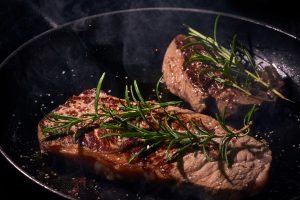
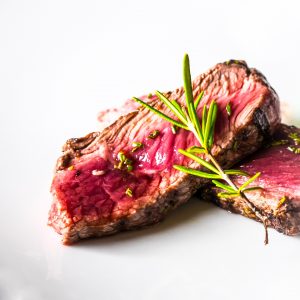
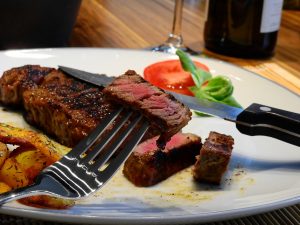
Yes, there is!

I’m going to share with you what I do to get a perfect piece of beef every time. These tips are good for whole meat, like steaks or roasts, not so much ground beef, but I will go over cooking ground beef, too.

But before you pull out the pan or fire up the grill, you need to know how grass-fed/finished beef is different from grain-fed.

What’s the Difference?

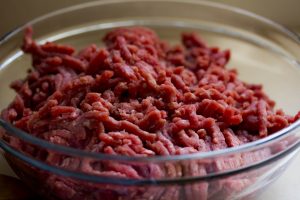
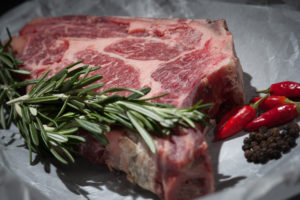
When it comes to cooking beef, grass-fed/finished beef is leaner overall.  There is marbling throughout our steaks, but it’s different from grain-fed/finished beef.  Grass-fed/finished beef has thinner marbling streaks throughout the meat compared to grained beef’s hunks of fat.

That means when you cook a steak, there is a fine line between rendering out too much fat and just enough to maintain tenderness.

Since there is less, albeit better quality, fat in grass-fed/finished beef you have less wiggle room between perfect and overcooking.

It may take some practice, but these tips will have you serving up steak dinners with confidence in no time!

Proper Defrost and Pre-Rest

Make sure you don’t start with a half-frozen piece of meat.  Take the meat out the day before and place it in the fridge on a rimmed cookie sheet or pan.  I love our toaster oven sized cookie sheets for this.

A pack of steaks or ground beef will be fine overnight, a roast may need an extra day, in the fridge.

If you forget to take it out of the freezer, you can put it on a cookie sheet set on top of a stove top grate or bowl (you want air circulation under) and flip it over every hour or so until defrosted.

Take the meat out of the fridge a minimum of 15 minutes before cooking it.  This is the pre-rest that helps get it closer to room temp. The larger the piece of meat, the longer you want it out.  A 5 lbs roast should be out for 30-45 minutes.

No, you will not get food poisoning from leaving the meat out of the fridge for this long.

Proper Cooking Temperature/Technique

If you buy and use a cast-iron skillet for nothing else, use it for meat. It makes cooking easier and it really does give it a better flavor.

What I’ve found is most people cook with either too low or too high of a heat.  With steak, you want to start high and go down to medium about halfway through.

For the crisp sear, use butter. Lots of butter.

I use the 1-minute flip technique for our steaks.  Cast-iron pan on high heat, add 2 Tablespoons of butter after 30 seconds, wait until it’s browning and bubbly, add your meat.

Either set a timer or watch the stove clock and with tongs, flip the meat away from you every minute.  After 4 minutes, turn down the heat just a tad to medium and continue cooking until you get to your preferred doneness.

And never, ever, never smash the meat with a spatula or poke and flip with a fork or knife.  You lose all of the juiciness that way.

Internal Temperature

The best way to know if it’s done to your liking is by using a meat thermometer.  Using a thermometer along with the touch test will help you not poke the meat too many times.

But aren’t meat thermometers expensive? Yes and no.  If you spend $50 on a thermometer and cook meat once a week, you spend 90 cents a meal to make sure it’s not overcooked.  Cook meat twice a week? You’re down to 45 cents a meal.

It’s worth the investment to not ruin quality meat. We use this one and this one as well.

We recommend our steaks at medium-rare, maybe even just barely medium. There will be some pink in the middle. We do not recommend cooking our steaks well done. If you like well-done beef, our cuts may not be for you.  The ground beef is fine well-done.

Rare 120-130F

Medium-Rare 130-35F

Medium 135-145F

Medium-rare?! What about the blooooooood!

That “blood” in your steak isn’t blood. It’s the protein myoglobin which helps muscle tissue store oxygen. Iron in the myoglobin turns red when it binds with oxygen, giving raw meat its red color. If you’ve ever bitten the inside of your cheek or lip, you know what blood tastes like. I doubt anyone would eat red meat if it tasted like blood.

Rest Time

You’ve been waiting all day for this steak dinner. You pull it out of the pan at a perfect 135F and you’re ready to dig in!

Don’t do it!  It needs to rest.

I used to think this was optional, but if you want the most from your beef, just wait 10-15 minutes.

The rest time allows the meat to finish cooking and helps to retain the moisture. If you cut it right out of the pan the juices will literally run out resulting in dry meat. Moisture = Tenderness

I use the rest time to saute veggies, usually onions and mushrooms, in the same pan so they are cooked and covered in all that buttery beefy fatty goodness. Spinach, kale, and squash are also good.

Ground Beef

Cooking ground beef is different from whole cuts like steaks or roasts.  Because it’s ground and has more surface area, i.e more places for possible contamination, it needs to be cooked to 160F.

When you are browning meat for tacos or spaghetti, cooking until you see no pink bits is usually the standard of doneness. Cooking meatloaf, meatballs, or burgers, you want to check the temp and make sure it’s up to 160F.

It doesn’t need the pre-rest, but I usually stick a butter knife through the middle to make sure it is fully defrosted. And it doesn’t need the post-cooking rest time either.

So now you know how to prep, cook, and rest grass-fed/finished beef for the perfect dinner your family will love!

Ready to order beef? Click here!

Have more questions? Want to share how the tips worked for you? Leave a comment.

Filed Under: Recipes Tagged With: Beef recipes

  • « Previous Page
  • 1
  • 2
  • 3
  • 4
  • Next Page »

Welcome to Stuart Farm!

We’re Serena and Fred Stuart. While raising healthy and happy animals is our #1 goal, we’re also here to serve you! If you’re looking for help in navigating healthy eating and living, you are in the right place! We’re here to answer your questions and help you feed your family meat and eggs you can feel good about. We share farm stories that gives you a peek into our life, recipes to try, health tips, and more. We hope you enjoy coming along on our farm adventures.

Connect with us

  • View StuartFarmLLC’s profile on Facebook
  • View stuart_farm’s profile on Instagram

Contact Us

573-764-2324 please leave a message .
Farm hours are by appointment only.

Tags

Beef recipes broth chickens delivery Devons Dorkings Eggs Farm Life Freedom Rangers garden lard pigs Pyrs raw diet recipes recipes sweets Silver Fox Rabbits Sugaring

Categories

  • Blog Posts (73)
    • Farm Life (39)
    • Mother Nature (1)
    • Our Animals (24)
    • Our Garden (2)
    • Pigs (5)
    • Projects (1)
    • Recipes (16)

Recent

  • 2025-2026 Our Years of Transition
  • Our Farmstay Is Now Open!
  • The Best Way to Take Charge of Your Health
  • Love is…
  • My Summer Reading List

Archives

Copyright © 2026 · Focus Pro Theme on Genesis Framework · WordPress · Log in

Loading Comments...