Stuart Farm

  • Our Story
  • Shop
    • Our Store
    • Where to Buy
  • Come Enjoy a Farm Stay!
  • Our Classes
  • Fertrell Products
  • Contact Us
  • Blog Posts
    • Our Animals
    • Mother Nature
    • Our Garden
    • Recipes
    • Farm Life
    • Projects
  • Consultation Services
  • 0 items

The Terroir of Meat

Posted on July 23, 2020 Written by Serena 2 Comments

If you know wine, you’ve probably heard the term terroir.

Terroir: /terˈwär/
noun: terroir

  1. the complete natural environment in which a particular wine is produced, including factors such as the soil, topography, and climate.
    • the characteristic taste and flavor imparted to a wine by the environment in which it is produced.

I was recently listening to Bread, Wine, Chocolate: The Slow Loss of Foods We Love by Simran Sethi and she wrote about terroir not just in wine but in chocolate, wheat, coffee, and beer.

So I started thinking about the conversations I’ve had with customers.

One woman said she like our beef better than another farm’s, even though we have the same practices, had cattle from the same herd, and lived only 20 miles apart.

People say our eggs are the best they’ve ever eaten, even though eggs they buy from other farms have the same practices as us.

So I started wondering…could it be terroir?

Yes, it is!

The main reason our meat tastes different from store-bought is that store-bought is all raised the same way. Year after year, raised in the same conditions, fed the exact same thing, butchered at the exact same age. Quality is not left to chance; it’s all about consistency.

On our farm, Mother Nature has a hand in what our meat and eggs taste like.  What grasses, forbs, brush, and “weeds” grow well this year.  Will there be an explosion of crickets or, if we’re really lucky, cicadas this year? Will a momma put on plenty of milk giving the baby a growth advantage? Did the oak, hickory, and walnut trees produce nuts well for the pigs? Did a mild winter mean less weight loss?  Did rains push more earthworms to the surface to feed the chickens and pigs?

It’s not just the environment that factors into our meat quality. When we butcher an animal, their age has a lot to do with the end product.

You’ll hear people say that a younger animal is more tender, not tough like an old breeder cow or sow.  What I talked about in this post, debunks that myth.

If what an animal eats gives its meat flavor, then the older the animal, the longer they eat, and more flavor they can develop.

Often, with customers new to eating heritage breeds, I’ll suggest they buy something from a variety of farmers to find what they like.  I tell them to find out where the farm is, the breed of animal, target age of butchering, feed type, and raising practices.  A Tamworth hog raised on pasture will taste different from one raised in a pen and a beef butchered after eating spring grass for two months will be very different than a beef months into a drought.

I’ve had customers say grass-fed beef is “too strong”.  What they’re tasting is actual beef flavor that store-bought just doesn’t have anymore.  I have a hard time putting anything but salt and pepper on our beef so the flavor isn’t covered up.  People joke that tofu tastes like whatever sauce you put on it. I feel the same way about store-bought meat and eggs.

So the next time you bite into that steak, chop, drumstick, or egg, know that what you are tasting is more than meat. It’s our farm, our practices, our breeds, our love.

It’s terroir.
Filed Under: Farm Life, Recipes Tagged With: recipes

Easy and Delicious Vietnamese Garlic Chicken

Posted on June 6, 2020 Written by Serena 2 Comments

Leg thigh quarters are by far our favorite chicken cut.  On the BBQ, split for fried chicken, roasted with all that crispy skin, always with moist dark meat. What’s not to love!

If you’ve always wondered how to prepare chicken quarters or need a new recipe for them, this post is for you.

This is a mash-up of Wellness Momma’s Honey Garlic Chicken Thighs and Milk Street’s Vietnamese Caramel Chicken. One didn’t seem spicy enough and the other had me standing over the stovetop, neither of which I really like.  Bring on the spice and let me walk away!

Easy and Delicious Vietnamese Garlic Chicken

Preheat oven to 375F.

4 Stuart Farm Leg Thigh Quarters

1/4 c. flour of choice

1/4 c. honey or maple syrup or a combo of the two

2 Tbsp coconut aminos or soy sauce

2 Tbsp water

4-6 cloves of garlic minced or through a garlic press

2 tsp fresh ginger chopped

2 Tbsp fish sauce

1 tsp Gochujang sauce or Schiracha (optional for some heat)

1 Tbsp lime juice

Dredge chicken in flour until coated and shake off excess.

Place in a shallow baking dish.

Whisk remaining ingredients (except lime juice) in a small bowl and pour over chicken.

Cover loosely (cookie sheet on top is fine) and bake 15 minutes.

Remove cover, spoon sauce over chicken. If the sauce is getting too thick add 2 Tbsp water to the pan.

Continue baking uncovered until internal temp reaches 165F.

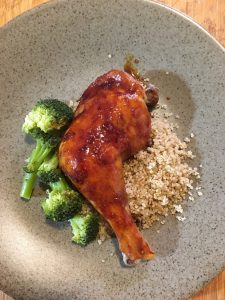
Drizzle lime juice over chicken and serve with steamed veggies and rice or quinoa.

Filed Under: Blog Posts, Recipes

What’s Slow Food?

Posted on February 5, 2020 Written by Serena 1 Comment

Like a lot of things I get into, I don’t remember how or where I came across Slow Food, but I’m soooo glad I did!
Slow Food is the opposite of Fast Food.  It’s good clean food made with real food ingredients. Think about what your grandmother used to cook, more than likely, it was Slow Food.

Slow Food is a worldwide organization that started in Italy.  From www.slowfoodusa.org:

“Over thirty years ago, a large group of Italians gathered in Rome for a protest. Why? A fast food franchise was opening at the base of the iconic Spanish Steps. Instead of throwing rocks and yelling, the activists brought in a big bowl of penne pasta and shared it with the crowd that gathered, chanting:  We don’t want fast food.  We want Slow Food! That gathering was the birth of the Slow Food movement. Today, we are in over 160 countries, with 150 chapters in the United States”.  To read more about Slow Food, click here.

Our Slow Food Chapter in St. Louis is amazing! Run by a group of volunteers, they put on monthly speaking engagements to help people understand the importance of buying from local farmers and how they can support and create their own local food system.
Throughout the year, classes and workshops are offered on everything from making the best cup of coffee to chocolate tastings and from cheese making to apple tree grafting.

They also put on fundraisers like an all locally sourced pancake breakfast to support programs like the Biodiversity Micro-Grant.

The Biodiversity Micro-Grant assists small farmers in producing heirloom varieties of produce and preserving heritage livestock breeds. The aim is to bring these products back into the St. Louis area. We have been the lucky recipient of 3 grants.

Momma

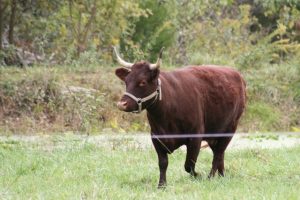
Our first grant helped us purchase our first cow/calf pair of American Milking Devons (AMD) in 2013. We were just starting our farm business and wanted cattle that did well in our area, we could train as oxen, and milk.  It was a big investment for us and the help from Slow Food St. Louis made a huge difference.  Momma has given us 5 calves and Clementine has given us 4 calves since arriving at our farm.

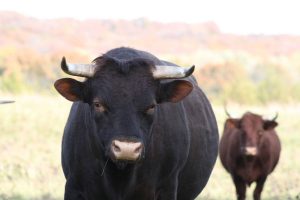
The second grant helped us purchase our bull, Reddington, in 2014. He has been a stellar bull for us. His temperament is cool and mellow. He “plays” gently with the steers, allowing them to test him without taking it personally.  He has sired 25 calves so far.

Reddington (www.kimcarrphotography.com)

So far we have been able to offer three AMD beeves to our customers with another three ready in 2020, five in 2021, and five in 2022. These two grants helped us increase our herd, help start two other herds in Missouri, and increase the overall numbers of the breed (~2000) in the world.

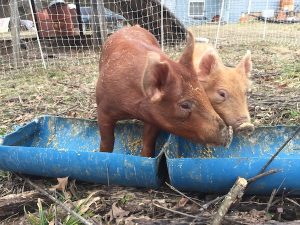
Our third grant (2020) helped us purchase a Tamworth boar to replace our Berkshire boar. Tamworths are gaining popularity and increasing in numbers but finding traditional stock is hard. Most are bred to be show pigs–shorter and stouter than the traditional tall and long Tams. We’ve loved our TamxBerk pork, but wanted to go back to our original plan of pure Tam pork and all their wonderful qualities.

Since it was a long drive to get him, we decided to get a gilt (female) to make the trip really worth it. The boar will be ready to start servicing the girls Fall 2020, so our Berkshire will continue his duties until then.  If we can find traditional stock semen, we’ll artificially inseminate the gilt and keep the best female from her to add to our breeders.

Our production has grown so much since we started in 2012 and a big part of that is because of Slow Food St. Louis and people who support their mission.

If you’d like to support Slow Food St. Louis and small farmers like us, here are a few ways you can do so.

1-Become a member. By joining, you’ll help keep the mission of good, clean, and fair food alive and well while helping to support programs like the Biodiversity Micro-Grant.  Click here to join.

2-Attend a speaking, class, workshop, or event. Almost every month there’s something going on. Click here for a calendar of events and follow them on Facebook to stay up-to-date. You’ll learn something new and meet a great bunch of people.

3-Make a tax-deductible donation. In addition to becoming a member, or in lieu of, you can make a donation by clicking here.  Your donation helps put on the events in #2 and helps support small farmers through the Biodiversity Micro-Grant.

From the bottom of our hearts, thank you Slow Food St. Louis and its supporters for all you’ve done for us, our fellow farmers, and the St. Louis area.

Want to find a chapter in your area?  Click here!

Filed Under: Farm Life

Corky’s Piglets

Posted on November 23, 2019 Written by Serena 2 Comments

I’m always excited about piglets.  The weeks leading up to the big day, trying to guess when it will happen, pampering the momma, even staying up late in the freezing cold, it’s all worth it.
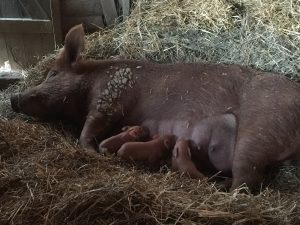
Last week, when I got home from driving my afternoon school bus route, Corky had started to farrow.  The nice thing about attending farrows is I get to know the changes in breathing and movement that go along with the process.

As I watched her, I knew she still had piglets to birth.  The way she kicked her legs, a certain grunt, it all said: “I’m working on more!”

I cleaned each one up and told Corky she was doing a great job. We don’t use heat lamps, so I made sure each stayed close to her for warmth.

I stayed with her for two hours while she added 3 piglets to her litter.

When she was having trouble getting one out, she’d half sit up, and roll back down.  Sure enough, one would come out right after.

But when she stood up, turned around, laid back down, I knew that was that. Her breathing slowed and was easy.  She softly grunted at the piglets to come eat and they did.

I waited another 20 minutes or so and the afterbirth came.  My heart sank.

She delivered 5 piglets.  One stillborn with leg deformities, four alive.  One of the four also had deformed legs and we had to put it down.

That leaves three piglets with this litter.  Her previous litters were eight and two.

If Corky were solely a pet, I’d be happy to keep her and never get another piglet from her. But she’s not a pet. And sows that produce so few piglets don’t work for our business.

These were to be our farmer market hogs, so our pork will be in short supply for the summer. Not a good thing.

Having piglets, even just three, is hard on the sow. After the piglets are weaned, we’ll let her regain her conditioning and make an appointment at the butcher.

It’s not an easy decision to make, but a necessary one for us to be sustainable, to continue producing meat, and to keep lesser quality genetics out of production.

I will enjoy these few months with Corky and when the time comes, cry my eyes out when we say goodbye.

Filed Under: Our Animals, Pigs Tagged With: pigs

  • « Previous Page
  • 1
  • …
  • 3
  • 4
  • 5
  • 6
  • 7
  • …
  • 19
  • Next Page »

Welcome to Stuart Farm!

We’re Serena and Fred Stuart. While raising healthy and happy animals is our #1 goal, we’re also here to serve you! If you’re looking for help in navigating healthy eating and living, you are in the right place! We’re here to answer your questions and help you feed your family meat and eggs you can feel good about. We share farm stories that gives you a peek into our life, recipes to try, health tips, and more. We hope you enjoy coming along on our farm adventures.

Connect with us

  • View StuartFarmLLC’s profile on Facebook
  • View stuart_farm’s profile on Instagram

Contact Us

573-764-2324 please leave a message .
Farm hours are by appointment only.

Tags

Beef recipes broth chickens delivery Devons Dorkings Eggs Farm Life Freedom Rangers garden lard pigs Pyrs raw diet recipes recipes sweets Silver Fox Rabbits Sugaring

Categories

  • Blog Posts (73)
    • Farm Life (39)
    • Mother Nature (1)
    • Our Animals (24)
    • Our Garden (2)
    • Pigs (5)
    • Projects (1)
    • Recipes (16)

Recent

  • 2025-2026 Our Years of Transition
  • Our Farmstay Is Now Open!
  • The Best Way to Take Charge of Your Health
  • Love is…
  • My Summer Reading List

Archives

Copyright © 2026 · Focus Pro Theme on Genesis Framework · WordPress · Log in

Loading Comments...